Somewhere between “we should really be doing more marketing” and “we need to hire a CMO” sits a gap that most growing businesses fall into. The work is too strategic for a freelancer, too ongoing for an agency project, and not big enough — yet — to justify a $150K+ executive hire.
That gap is where fractional marketing lives. But “fractional” has become one of those words that means something different in every LinkedIn bio, so here’s what it actually looks like in practice.
The short version
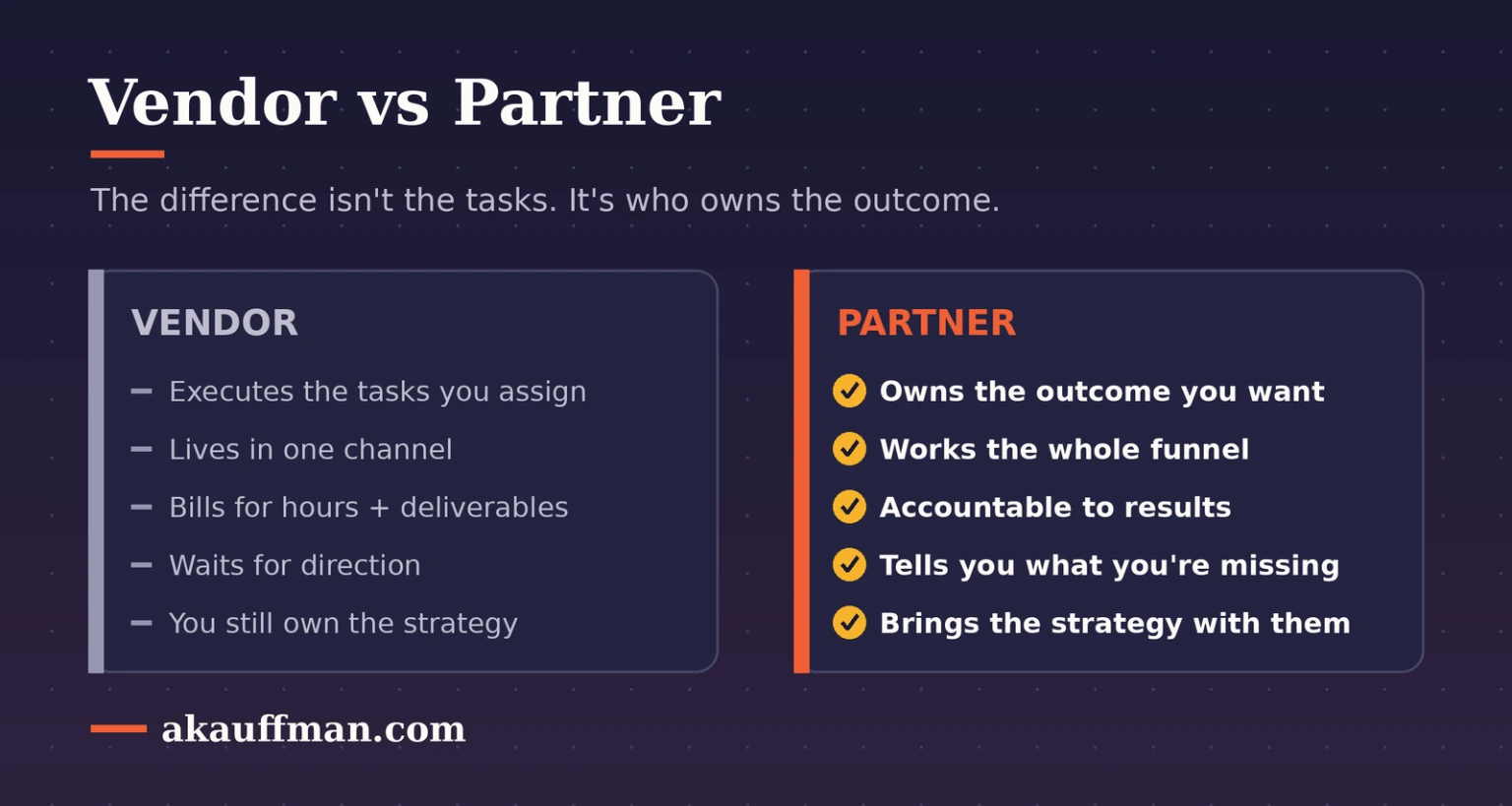
A fractional marketing partner is a senior marketer who joins your business part-time and works like an owner, not a vendor. Same person in your meetings every week, same person accountable for the numbers — just not on your payroll five days a week.
The difference from the alternatives comes down to ownership. A consultant hands you recommendations and leaves the doing to you. An agency does the doing, but inside their process and their tools — when the contract ends, the capability leaves with it. A fractional partner sets the strategy and does the work and answers for the results, inside your business.
What a typical month looks like
Every engagement is different, but a representative month with a client might include: a strategy session to set priorities against the pipeline goals, hands-on management of paid search and social campaigns, an SEO review with fixes shipped (not just listed), a look at what the website’s conversion data is saying, and a report that ties all of it to revenue — not impressions.
Notice what’s missing: a discovery phase that lasts a quarter, a deck nobody reads, and a junior account team learning your business on your budget.
What it costs
Fractional engagements at the leadership level typically run anywhere from $750 a month for advisory-weight retainers up to $10,000+ a month for embedded head-of-growth arrangements. The range depends on scope: how many channels, how much execution versus guidance, and how fast you want to move. Either way, you’re getting senior experience for a fraction of what that person would cost as a full-time hire — and with none of the ramp-up risk.
A useful test: if your marketing decisions are currently being made by whoever has a spare hour — usually the founder, usually at 9pm — you’re ready for fractional help. The strategy gap costs more than the retainer.
Who it’s for (and who it isn’t)
Fractional works best for businesses that have proven demand exists — customers are buying, referrals are happening — but growth is limited by marketing capacity and expertise. It’s a poor fit if you’re pre-revenue and need someone to find product-market fit, or if you’re at the scale where marketing genuinely needs a full-time executive and a team under them. A good fractional partner will tell you when you’ve reached that point — and help you hire for it.
The question to ask before hiring one
Ask any fractional marketer this: “What happens if the numbers don’t move?” You’re listening for ownership. If the answer is about deliverables completed and hours logged, you’ve found a vendor. If the answer is about what they’d change, test, and take responsibility for next — that’s a partner.
What this looks like in practice
The difference between a vendor and a partner shows up in the tactical calls — reading a platform change for what it actually means, not what the dashboard says. A couple of recent examples of that thinking: why rising CPCs are rarely a bidding problem, and what Google’s Smart Bidding update really changes for your targets.