Updated July 17, 2026: Google has published its official announcement and clarified the mechanism behind the change (the ~80% budget-utilization throttle, or “true target”). This post has been updated with how it works and what to set your targets to.
On August 17, Google is changing how Smart Bidding behaves in budget-limited campaigns using Target CPA and Target ROAS — and the paid media world is, predictably, on fire about it. Advertisers are calling it “one of the most self-serving Google-centric changes in years.” Google is calling it predictability. Here’s my take after managing paid search budgets through a decade of updates like this one: Google isn’t stealing your efficiency. It’s calling your bluff.
What’s actually changing on August 17
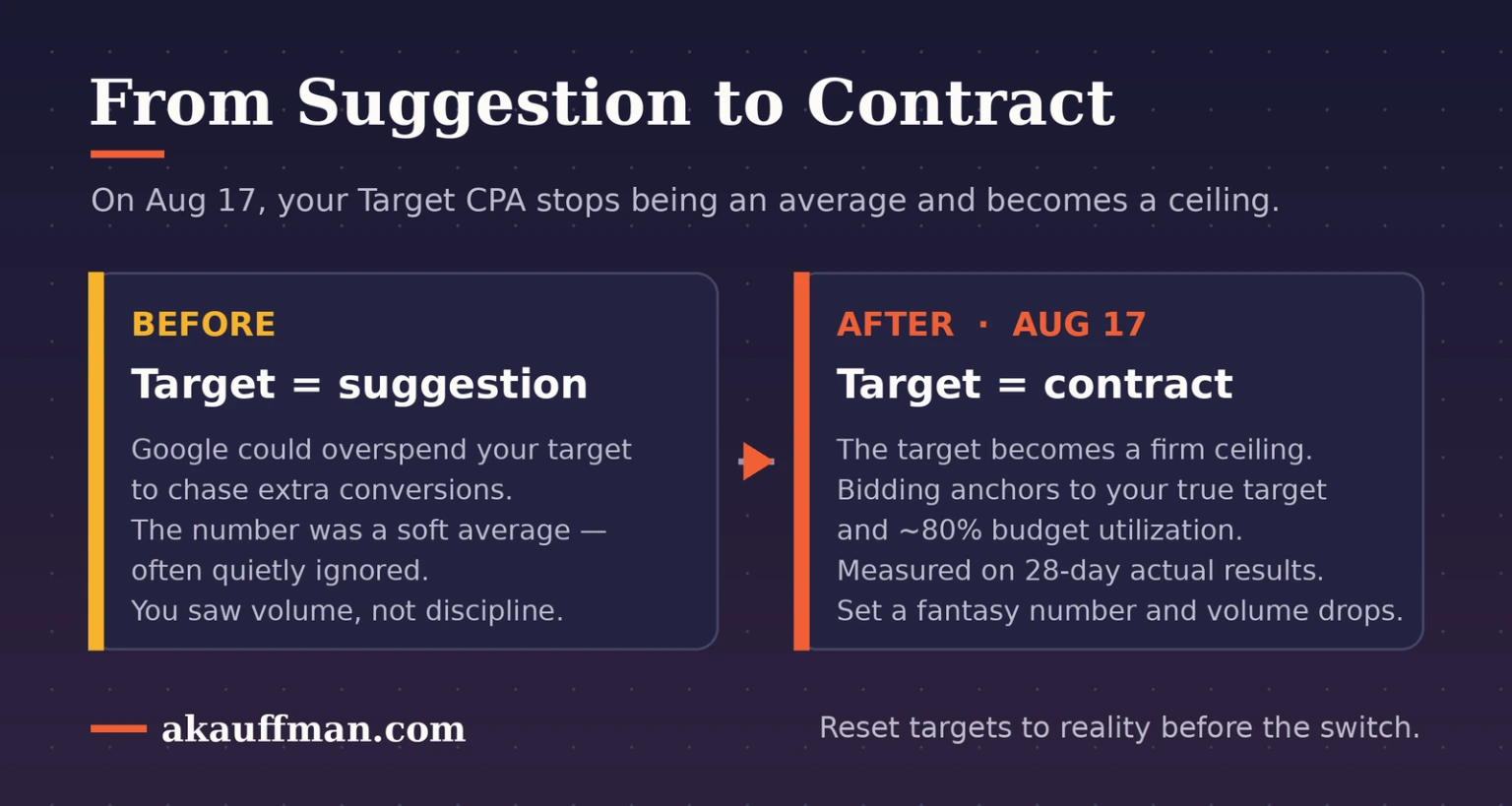
Today, a budget-limited campaign with a $25 Target CPA often converts at $14. Smart Bidding, constrained by your budget, cherry-picks only the safest auctions — so it quietly outperforms the target you set. Starting August 17 — and rolling out over the following few weeks — that ends. Google will optimize budget-limited tCPA and tROAS campaigns toward the target you actually entered, even when it could do better. Your $25 target stops being a ceiling and becomes the goal.
The mechanism: what “true target” actually does
Here’s the part that makes it click. Today, Smart Bidding on a budget-limited campaign quietly throttles at roughly 80% budget utilization — it holds back the last ~20% of your budget and spends it only on the highest-value auctions it can find. That reserved slice is what manufactures the overperformance: your ROAS looks inflated because the algorithm is cherry-picking with a chunk of your money held in reserve.
The August 17 change — Google’s “true target” — removes that reserve. Your targets become the single source of truth across the full budget, not just the 80% the system was actively working. Overperformance doesn’t disappear, but where it comes from changes: it now has to be earned by real demand and creative strength, not conjured by an algorithm sitting on your last 20%.
The change hits Search, Shopping, Performance Max, Demand Gen, and Travel campaigns (Display and Hotel already work this way), across Google Ads, Search Ads 360, DV360, Editor, and the API. Google has been clear about what it won’t do: it won’t raise your budgets and it won’t touch your targets. But if your targets don’t reflect reality by August 17, the system will happily spend its way up to the number you gave it.
Why everyone is angry — and why they’re half right
The backlash has a legitimate core. Many sharp advertisers set loose targets on purpose — a high tCPA or low tROAS gives Smart Bidding room to explore new customers instead of remarketing the same reliable converters. That lever effectively disappears. And brand campaigns, which chronically outperform their targets on cheap, high-intent traffic, are the most exposed accounts on the internet right now. A brand campaign coasting at a $5 CPA against a forgotten $10 target can legitimately see its acquisition cost double — not because Google raised prices, but because you told it $10 was acceptable.
So yes: if you do nothing, this update costs you money. The six-week runway between the Bid Target Adjustment Tool (live July 6) and the rollout is tight for agencies managing hundreds of accounts. That criticism is fair.
But there’s a real upside hiding in the complaints: predictable scaling. The old throttle is also why pouring more budget into a winning campaign so often tanked its ROAS — you were feeding auctions the algorithm had deliberately been avoiding. With the reserve gone and targets enforced across the full budget, that ROAS-drop-on-scale risk largely goes away. For anyone who’s ever been afraid to scale a good campaign, that’s the quiet win in this update.
The uncomfortable truth: your target was a lie
Here’s the part of this conversation I think the industry is dancing around. If your campaign has delivered a $14 CPA for nine months against a $25 target, your target isn’t a strategy — it’s a stale setting nobody revisited. The overperformance wasn’t your cleverness; it was a gap between what you told Google and what you actually wanted. Google is now closing that gap and forcing a question most accounts have avoided for years: what is a conversion actually worth to you?
After August 17, your Target CPA stops being a suggestion and becomes a contract. Set it like one.
That’s not a defense of Google’s motives — a system that bids closer to your stated tolerance is also a system that captures more of your willingness to pay, and anyone who ignores that is being naive. Both things are true: this helps Google’s revenue and it punishes sloppy account management. You can’t control the first one. The second one is entirely yours.
The bigger picture: this is one of three changes
Google’s official announcement frames the target enforcement as the third leg of a coordinated bidding overhaul. The first two are the carrots: Smart Bidding Exploration — where you set a ROAS tolerance and let Google chase converting queries you aren’t currently winning — is expanding to all Performance Max campaigns without a product feed, with a beta open for Shopping. Google claims campaigns using it see an average +18% increase in unique converting search query categories and +19% more conversions. And a new promotion mode (beta, Search and PMax) lets you schedule temporary ROAS-tolerance changes and extra daily budget for peak periods — seasonal events, flash sales, launches.
Read the three together and the strategy is plain: Google is replacing the old habit of “set a loose target and let the campaign overdeliver” with explicit, structured flexibility. Want exploration room? Use the exploration feature and set a tolerance. Want seasonal aggression? Schedule promotion mode. What you can no longer do is get either one implicitly by leaving a stale target in place — the enforcement change closes that door. Same flexibility, but now you have to declare it. Which, for what it’s worth, is also better client communication: a documented tolerance beats an unexplained overperformance every time.
One more practical detail from the announcement: notifications began appearing in Google Ads on July 6 flagging campaigns that need target adjustments, with historical performance and one-click updates. If you manage an account, that notification queue is your pre-flight checklist.
What to do before August 17 (in this order)
1. Find your exposed campaigns
Filter for campaigns that are (or were recently) “Limited by budget” and running tCPA or tROAS. Google is sending notifications and the Bid Target Adjustment Tool flags them — but do your own audit, and don’t forget SA360, DV360, and anything managed through the API. Brand campaigns first.
2. Reset targets to reality
Google’s specific recommendation for budget-limited, over-achieving campaigns: set your target to the campaign’s 28-day historical actual ROAS (or CPA), using the review tool it’s surfacing in-account. If actuals are meaningfully better, tighten the target to match: a campaign delivering 900% ROAS against a 500% target should be set to ~900%. Per Google’s own guidance, matching the target to current delivery preserves current performance with no expected impact on volume. This is a ten-minute fix that prevents a real budget bleed.
3. Rethink where a target is even the right tool
If you were using a loose target to buy exploration room, that trick is dead. Consider Maximize Conversions or Maximize Conversion Value without a target where volume matters more than a fixed efficiency number — or keep the target and accept stricter delivery. Either is defensible; drifting into August without deciding is not.
4. Change one thing at a time
Smart Bidding needs one to two conversion cycles (often about a week) to stabilize after a target change. Don’t stack a target change, a budget change, and a strategy change in the same week and then blame the algorithm. If you’re scaling budgets, do it incrementally and watch delivery between steps.
My POV: this rewards exactly one kind of advertiser
Every Google Ads shakeup — this one, Performance Max, the death of enhanced CPC — transfers money from passively managed accounts to actively managed ones. Advertisers who treat targets as living settings tied to unit economics will come through August 17 essentially untouched, and may even benefit from more predictable scaling. Advertisers who set a number in 2024 and let it ride are about to fund everyone else’s auctions.
The real lesson isn’t about bidding mechanics. It’s that the platforms will always optimize toward what you tell them, not what you meant. Clean targets, clean conversion tracking, and a number tied to actual revenue — that’s the whole game, before and after August 17.
Need a second set of eyes before the deadline?
I’m auditing budget-limited campaigns for exactly this exposure right now. If you’re not sure whether your account is affected — or your “targets” haven’t been touched in a year — book a free strategy call and we’ll go through it together before Google decides for you.