If your local search traffic has quietly slipped — fewer clicks, fewer calls, customers who seem to find you and then vanish — you’re not imagining it, and it’s not a bad month. The map results you fought to rank in are increasingly being answered over. Google now resolves the question inside an AI Overview, and the customer never scrolls to your pin.
Here’s the stat that should reframe every local SEO conversation you’re having: AI Overviews now appear on 68% of local searches, while the local pack shows up on just 39% (Whitespark, via Search Engine Journal). That’s a 29-point gap where your customers get their answer without ever seeing the map you optimized for.
The Map Pack isn’t dead — it’s shrinking to one job
Simple transactional searches — “tacos San Francisco” — still lean on the local pack. But the moment intent gets more human, AI takes over. Informational queries like “how long does an eye exam take near me” trigger an AI Overview 92% of the time. Hybrid queries like “average cost of dental implants in Phoenix” hit 97%. And “how much does X cost” queries pull an Overview more than 80% of the time.
Read that again: if your business answers questions rather than just fulfilling a one-word transaction, you already live almost entirely in AI Overview territory. The pin on the map now handles a shrinking slice of the demand, and your real competitive set just exploded — you’re no longer fighting the shop down the street, you’re fighting anyone who answers the question better than you do.
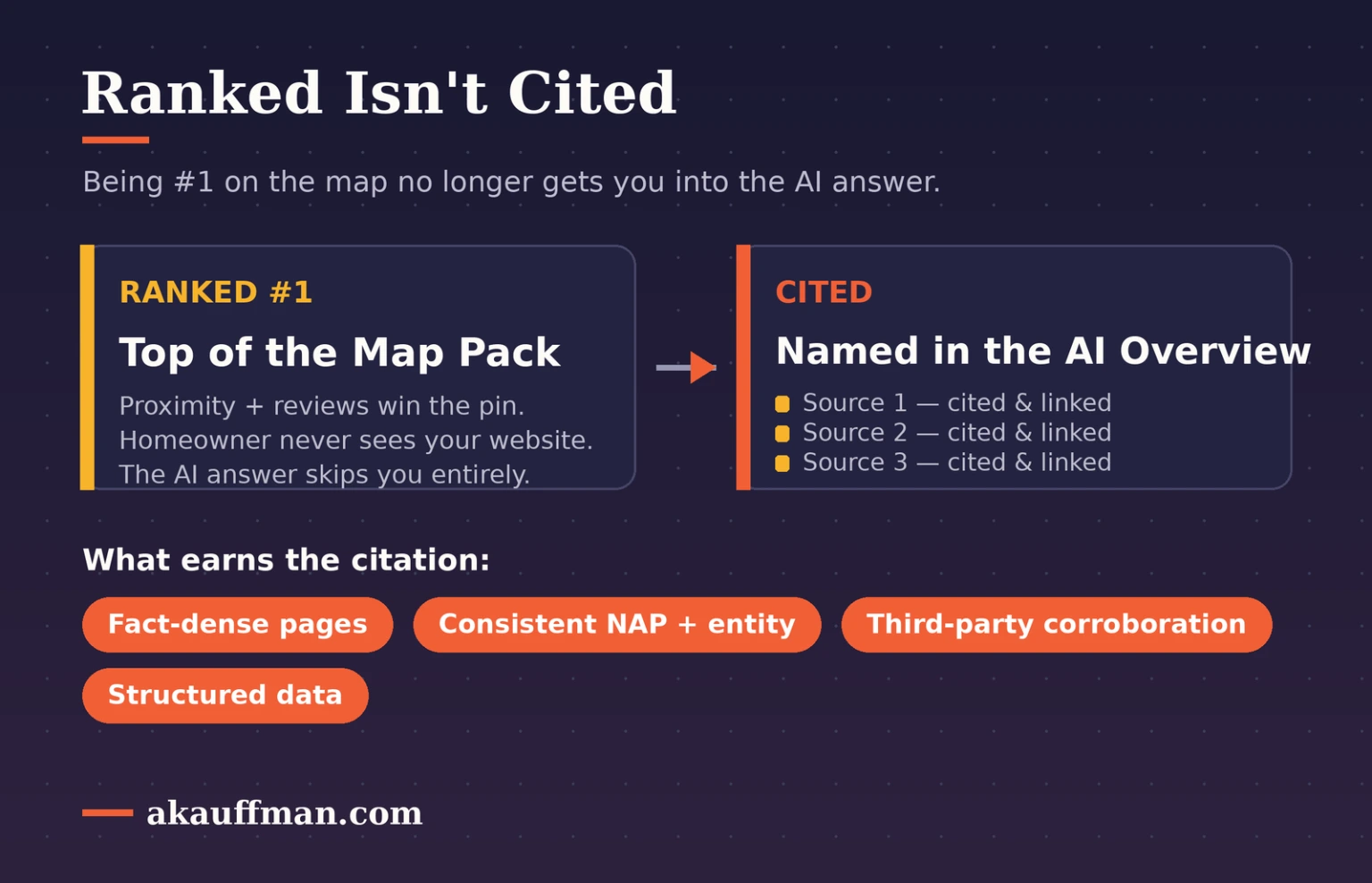
Why being #1 on the map doesn’t get you cited
This is the part most local SEO still gets wrong. An LLM doesn’t skim your location page the way a human does. It’s a pattern machine hunting for fact density — structured, specific, extractable statements it can cite with confidence. A 200-word page that “serves Nashville with pride” and repeats your service list gives it nothing. A page with a NAP table, city-specific FAQs, real local pricing ranges, and named neighborhood detail gives it everything.
And most of the citation doesn’t even come from your own site. Analysis of 23,000+ citations found owned content accounts for only about 23% of citations in branded queries — the other 77% is off-page. Reddit alone is the single most-cited source in AI Overviews (~21%), YouTube close behind (~19%), and AI-cited content skews 25.7% fresher than traditionally-ranked content (Ahrefs, 17M citations). Your Map Pack ranking is one input into a much bigger confidence score.
Traditional SEO earned you a rank. AI search earns you a citation. Those aren’t the same thing — and only one of them decides whether the customer calls you or never knows you exist.
What to actually do (in this order)
1. Rebuild location pages for fact density, not keyword coverage
Kill the cookie-cutter template. Every location page needs a table-formatted NAP/hours/service-area block, city-specific FAQs (permits, local regulations, climate), real local project examples, and a structured pricing/service grid. Tables and FAQ schema aren’t decoration — they hand the AI labeled, extractable facts. And getting the direct answer high on the page matters: ~44% of AI citations come from the first 30% of the content.
2. Prove you’re actually local
Google’s vision AI reads your images for geographic legitimacy. Generic stock photos of smiling professionals read as boilerplate. Use real, named local landmark imagery — descriptive filenames, location-referencing alt text, proper attribution. A Denver page with Red Rocks, the 16th Street Mall, and the Capitol signals “local” before the AI reads a word.
3. Lock down entity consistency everywhere
AI cross-references your location page against every directory it can find. If your NAP, hours, or service categories disagree between Google Business Profile, Yelp, Apple Maps, and your site, the AI’s confidence — and your citation odds — drop. Make every node say the exact same thing, and audit it quarterly.
4. Publish the cost and pricing guides your competitors won’t
“Price/cost/buy” queries trigger Overviews 80%+ of the time, and most local businesses refuse to answer them. You don’t need fixed rates — give honest ranges and explain the variables (square footage, materials, urgency, permits). If you won’t answer “how much does this cost,” AI finds someone who will, and that someone gets the citation, the traffic, and the call.
5. Build citation authority off your own site
Since 77% of citations are off-page: earn genuine reviews, optimize YouTube descriptions with local terms, participate authentically in local subreddits, and publish proprietary local data nobody else has (an annual cost report, local benchmarks). Original data creates citation gravity generic content never will — and freshness compounds, so build a quarterly refresh cadence.
My POV: the window is the whole story
These AI systems are still building their index of trusted local sources — which means there’s roughly a 12-to-18-month window to become the cited authority in your market before competitors catch on. The businesses that rebuild now will own a citation moat that compounds. The ones waiting for it to “stabilize” will spend years trying to unseat whoever claimed their niche first.
And here’s the uncomfortable part for a lot of businesses: the vendor optimizing your Google Business Profile this month is optimizing yesterday’s game. Chasing the Map Pack while you’re invisible in the answer is the new local SEO trap — you can be #1 on a map nobody looks at. Seeing that shift, and rebuilding for it before the window closes, is exactly the difference between a vendor and a partner.
The bottom line
Local SEO didn’t die — it moved. The scoreboard changed from rank to citation, and most businesses are still checking the old scoreboard. Rebuild your location pages for fact density, prove you’re real and local, keep your entity consistent, answer the money questions, and feed the off-page ecosystem that AI actually cites. Do it in the next year and you own your market’s answer. Wait, and you’ll be explaining to yourself why the phone stopped ringing.
Invisible in the AI answers for your market?
If you rank locally but can’t tell whether AI Overviews or ChatGPT are citing you — or your location pages still read like a template — book a free strategy call and we’ll map out how to become the cited authority before your competitors do.