Sometime in mid-June, a lot of ecommerce dashboards quietly jumped. Impressions up. Clicks up. Maybe a celebratory Slack message or two. Here’s the uncomfortable part: for most of those accounts, nothing about performance actually changed. Google changed what the reports count.
What actually changed
As of June 15, Google expanded product-level reporting for Performance Max. Product metrics — impressions, clicks, cost, conversions — used to reflect only activity on Search networks and Standard Shopping campaigns. Now they include product performance across all Performance Max networks, plus video, app, and Demand Gen campaigns where products flow through Google Merchant Center.
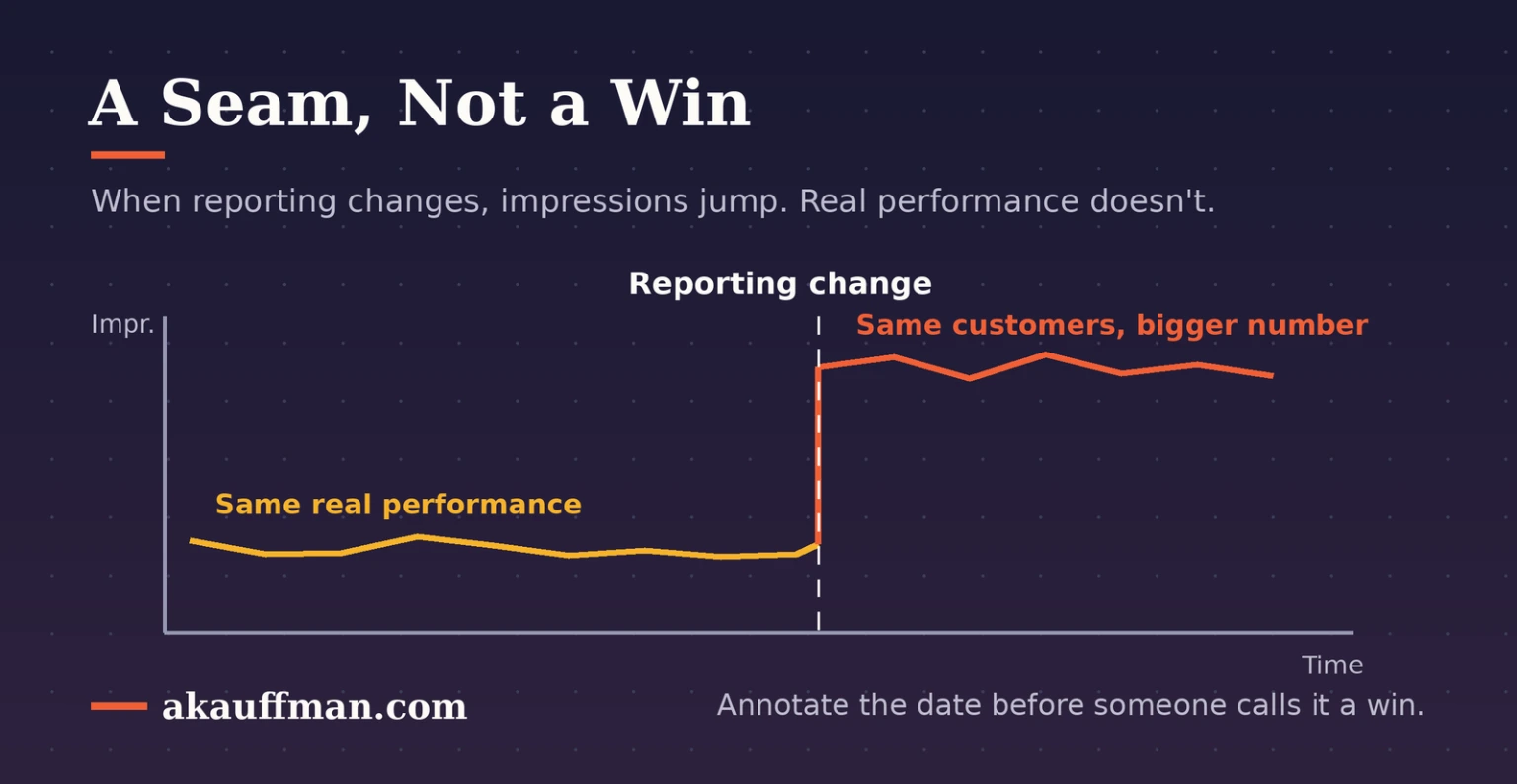
Google’s own notice says the quiet part clearly: this “may cause a one-time increase in metrics such as impressions, clicks and more for Performance Max campaigns only.” In other words — the spike is the measurement, not the marketing.
This is a good change. It’s also a trap.
Let me be fair to Google first: this closes a real blind spot. PMax has always spent your money across YouTube, Display, Gmail, Discover, and Maps — but product reports only showed you a slice of it. A more complete picture is genuinely better, and long-term this is the reporting ecommerce advertisers should have had all along.
The trap is the seam. Every month-over-month comparison that crosses June 15 is now comparing two different measurement scopes. Impressions and clicks jump while conversions move less, so calculated metrics shift too — CTR and conversion rate can drop on paper while nothing real happened. An account that “grew 40% in June” may have grown 5%. An account whose CTR “collapsed” may be perfectly healthy. Neither number means what it appears to mean.
The most dangerous platform changes aren’t the ones that break something. They’re the ones where nothing breaks — the account just looks different, and everyone starts explaining a story that isn’t there.
What to do about it (before someone asks)
1. Annotate everything, today
Put a June 15, 2026 annotation on every dashboard that touches PMax product data — Google Ads, GA4, Looker Studio, the spreadsheet your client actually reads. Six months from now, nobody will remember why the line jumped. The annotation is the institutional memory.
2. Use the network filter to isolate what’s real
The Network (with search partners) segment breaks down where activity is coming from. That’s how you separate genuinely new traffic from newly visible traffic — and how you answer “where did these impressions come from?” with a specific answer instead of a shrug.
3. Footnote every benchmark that crosses the seam
Month-over-month and quarter-over-quarter comparisons need an asterisk until you’ve lapped the change. If you report to clients or a CFO, add one line: “Reporting scope expanded June 15; pre- and post-June figures are not directly comparable.” One sentence now beats an awkward conversation later.
4. Check anything automated that keys off impressions or clicks
Automated rules, budget pacing scripts, anomaly alerts, agency dashboards with hardcoded thresholds — anything that reacts to impression or click volume can misfire on a scope change. Review the triggers before they “catch” a problem that doesn’t exist.
5. Tell your clients before their dashboards do
If you manage paid media for anyone, this is the week to send the two-paragraph heads-up email. The marketers who look best this month aren’t the ones with the biggest spike — they’re the ones who explained the spike before anyone asked.
My POV: reporting literacy is the job now
Google ships changes like this constantly — scope expansions, attribution tweaks, default changes — and each one silently rewrites what your historical data means. The skill that separates a partner from a report-forwarder isn’t reading dashboards; it’s knowing when the dashboard itself changed. Numbers going up is not the same thing as growth. Knowing the difference is what you’re actually paying a marketer for.
Also covered by Search Engine Roundtable.
Managing PMax for clients?
If your Performance Max reporting looks suddenly different and you want a second set of eyes on what’s real versus what’s reclassified, book a free strategy call — I’ll help you separate the signal from the scope change.