The previous program spent the budget and reported the clicks. Ninety days after the transition, the account was spending 23% less and reporting qualified leads, booked visits, and closed-won deals instead.
The situation
The client is a multi-location nonprofit healthcare organization. Each location has its own capacity to fill and its own local market dynamics. Paid search runs across a location-level ad account for each site plus a brand-level account. In early 2026 the program moved from its previous agency to us.
This is a high-stakes lead business. A single closed-won deal represents years of recurring revenue, and each location needs a different mix of inquiries depending on what it has room for. Spending without lead-quality tracking means optimizing blind.
The challenge
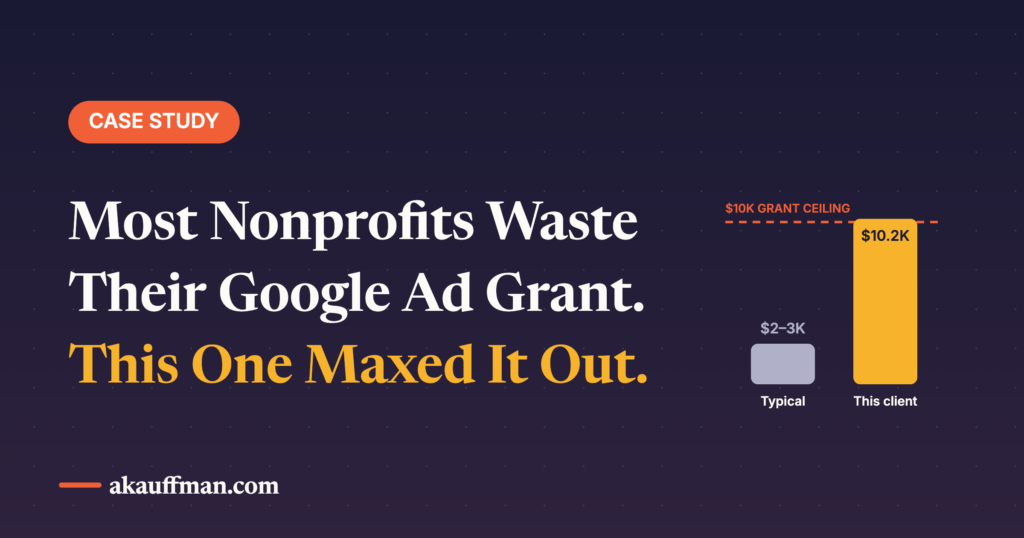
The previous program executed requests but brought no strategy. Google Ads was spending only about three-quarters of the approved monthly budget, with little structure connecting spend to what each location actually needed. As a nonprofit, the organization qualified for Google Ad Grants, the free search budget Google offers to eligible nonprofits, yet no grant account existed. And nothing connected ad clicks to what matters: qualified inquiries, booked visits, and closed-won deals.
The solution
Measure what matters before spending a dollar
The first build is measurement, not media. Lead-quality tracking runs across every form and phone call and connects to the organization’s inquiry system, so campaigns are judged on qualified inquiries, visits, and closed-won deals rather than raw clicks and form fills. That changes which campaigns look good, and therefore where the budget goes.
Restructure spend around each location’s needs
Each location gets its own budget and targeting matched to what it needs to fill. Where local demand is thin rather than underfunded, the approach changes instead of the budget: geography expands and proximity messaging gets its own landing pages, so a location with a small local market can draw from the next one over.
Put Google’s nonprofit money to work
Google Ad Grant accounts are stood up and eligible demand migrates there, the same play that maxed out a grant account for another nonprofit. One location proves the model first: after a strong test on a small paid budget, its program moves fully to the grant account and its paid spend falls to a fraction of the prior year’s. The freed dollars go to locations where paid coverage earns it.
The results (first 90 days vs. the same period a year earlier)
| Metric | Result |
|---|---|
| Qualified leads | 205 |
| Booked visits | 56 |
| Ad spend vs. prior year | −23% |
| Leads that booked a visit (CVR) | 29% |
| Visits that became closed-won deals | 15% |
Lead, visit, and closed-won figures are qualified inquiries tracked in the client’s lead management system as of the 90-day review. Spend is Google Ads platform-reported, spring 2026 versus the same dates a year earlier, across all of the organization’s ad accounts.
Paid search carried nearly 40% of the qualified leads the full digital program generated in the period, and the quality showed downstream: roughly three in ten leads booked a visit, and roughly one in seven visits closed.
The client noticed. Within the quarter, the results were being cited in the organization’s own board reporting, and location leadership credited the new program for improved numbers without being prompted.
Why it worked
Nothing here required more budget; it required knowing what the budget was doing. Lead-quality tracking turned paid search from a click machine into a pipeline tool. Per-location budgets matched spend to what each site needed to fill. And the Ad Grant migration made Google fund the demand it was willing to fund, so paid dollars only went to campaigns that earned it.
Cutting spend 23% while producing deals the client brings up in board meetings is what a good results-driven program looks like when measurement comes first.
Spending on paid search but can’t tie it to closed-won deals?
Most lead-gen accounts have a measurement problem before they have a media problem. Get an audit that shows what your spend is actually producing.