A founder sent me a “TikTok ads for ecommerce” guide last week and asked if it was time to turn the channel on. The guide was fine. It was also describing a platform that no longer exists: 2021 user stats, five manual bidding options, pick a goal, upload a video, “click submit.” That was TikTok three years ago. The 2026 version asks you a harder question before you spend a dollar, and most guides skip it entirely.
The question is this: is TikTok going to be your storefront or your billboard? You can run both. You can’t run them as one thing, and the accounts that try end up with a blended ROAS nobody can explain.
What actually changed
Three things, and they compound.
TikTok Shop ate the ad product. Since September 1, 2025, every TikTok Shop ad has to run through GMV Max. The old Video Shopping, Product Shopping and LIVE Shopping formats can’t be created or edited anymore. GMV Max is a fully automated campaign: you give it products, a budget and a target ROI, and it pulls your organic videos, affiliate creator posts, lives and ads into one system that optimizes for gross merchandise value. You don’t pick audiences. You don’t pick placements. You barely pick creative.
Off-platform got automated too. If you’re sending traffic to your own site, the default is now Smart+, TikTok’s version of Advantage+ and Performance Max: automated targeting, bidding and creative selection against a conversion event on your pixel. Manual campaigns still exist, but the platform’s roadmap is not headed that way.
Creative became a volume game. In June at Cannes, TikTok launched Symphony Agent, an AI layer inside Creative Studio, Content Suite and TikTok One that generates video, surfaces creator content and builds briefs from a chat prompt. Read that alongside the fact that the algorithm decides who sees your ad based on how the creative performs, and the message is clear: TikTok wants dozens of variants from you, not one hero video.
Underneath all of it, the channel is bigger than the old guides assume. NielsenIQ data reported by EMARKETER puts TikTok Shop’s US sales up 84% between March 2025 and February 2026, with roughly a quarter of US digital buyers expected to purchase on the platform this year. And with the US ownership question settled in January, the “will it even be here next year” objection is off the table.
Storefront vs. billboard: the decision most brands skip
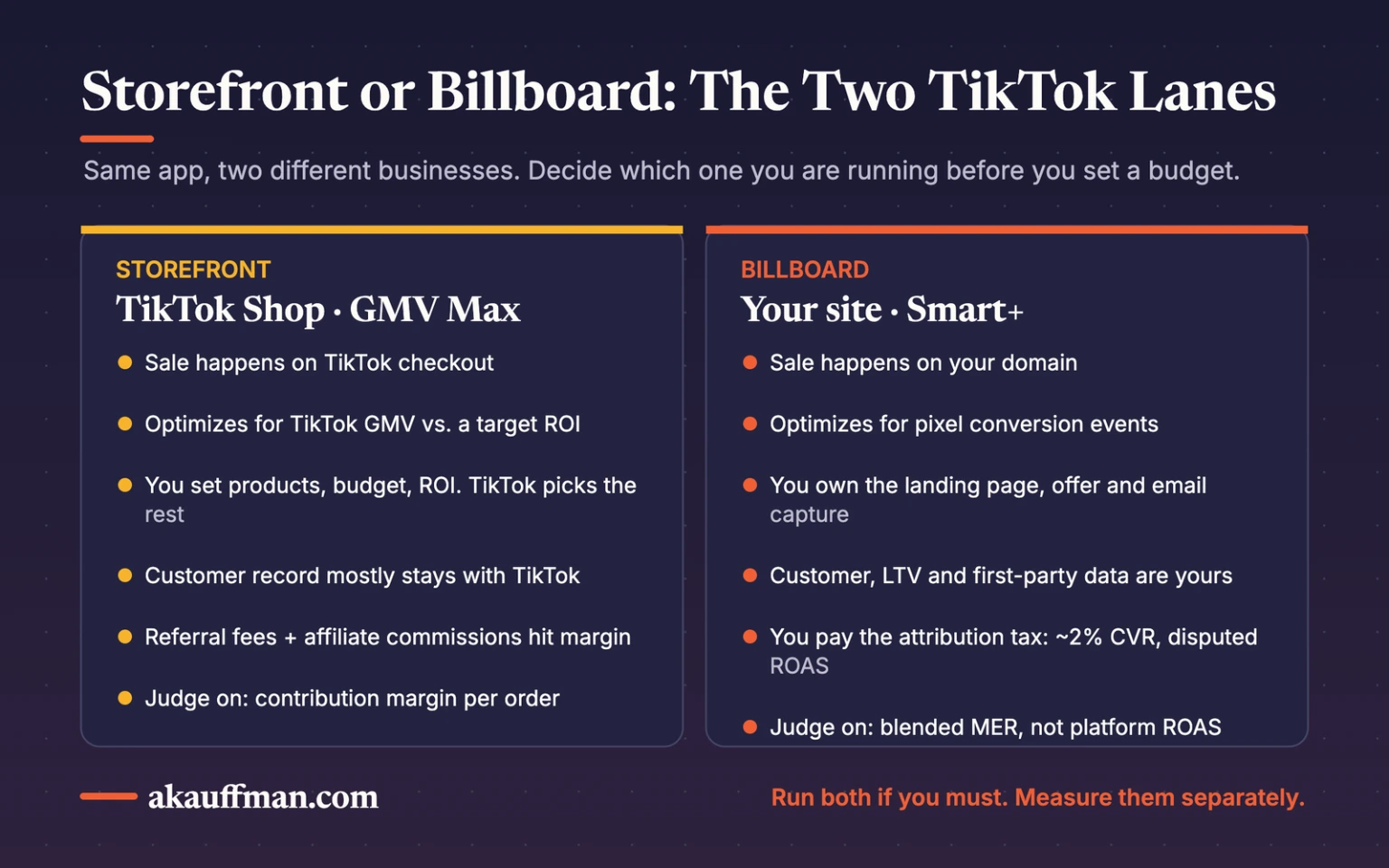
Here’s the fork. If you run GMV Max, the sale happens on TikTok. Checkout is theirs, the customer record is mostly theirs, the referral fees and affiliate commissions come out of your margin, and the algorithm is optimizing for GMV inside their walls. In exchange you get the lowest-friction purchase path on the platform and an algorithm that will happily push your product to people who buy things on TikTok.
If you run Smart+ to your site, the sale happens on your domain. You own the email, the retention flow, the lifetime value and the first-party data. In exchange you pay the attribution tax: a full-screen video feed sends traffic that converts at roughly 2% on a good day (Lebesgue’s 2026 benchmarks put the median around 1.9%), and TikTok’s pixel will always claim more credit than your books will confirm.
Neither is wrong. Pretending they’re the same channel is. They have different economics, different creative, different measurement, and different definitions of “working.”
TikTok will happily be your storefront or your billboard. It just won’t tell you which one you picked.
The balanced take
The automation is good. GMV Max really does simplify a system that used to require four campaign types and a spreadsheet, and Smart+ removes a lot of the manual tinkering that never moved the needle anyway. For a lean ecommerce team, that’s a gift.
The trap is that automation optimizes for what it can see. GMV Max sees TikTok GMV. Smart+ sees pixel events. Neither one sees your contribution margin, your return rate, your repeat purchase rate, or the fact that a Shop customer who never hits your site is worth less to you next year than a site customer who joined your list. You have to bring that math yourself, and the platform will not remind you.
What to do (in this order)
1. Pick a lane, or run two campaigns with two scorecards
Decide up front: storefront (GMV Max, on-platform checkout) or billboard (Smart+ to your site). If you’re going to run both, budget them separately and report them separately. A GMV Max campaign judged on site ROAS will look like a failure. A Smart+ campaign judged on TikTok GMV will look invisible.
2. Do the margin math before the media math
For Shop: list your referral fee, affiliate commission, shipping and ad spend against unit margin and find the ROI target that’s actually break-even. That’s the number you give GMV Max, not the one TikTok suggests. For site: decide what a first-order loss is worth given your repeat rate, and set the Smart+ target from that.
3. Build a creative pipeline, not a creative
Plan for volume: creator videos run as Spark Ads, your own founder-to-camera clips, product demos, and AI-assisted variants from Symphony as the multiplier, not the source. TikTok reads early engagement and decides distribution from it. Ten honest variants beat one polished spot every time.
4. Fix measurement before you scale
Pixel plus Events API on the site, UTMs on every destination link, and a weekly blended number (total revenue over total ad spend) that you trust more than either platform’s ROAS. When the blended number moves with TikTok spend, scale. When it doesn’t, the platform’s dashboard is lying to you politely.
5. Respect the learning phase
Both GMV Max and Smart+ need a stable budget and a stable target to exit learning. Changing the budget every other day resets the clock and you’ll conclude the channel “doesn’t work” when what didn’t work was your patience. Set it, feed it creative, and judge it on a two-week window.
6. Make the landing page match the feed
If you’re the billboard, the click lands on a page that has to load in a couple of seconds on a phone, show the exact product from the video, and let someone buy with one thumb. Most of the “TikTok traffic doesn’t convert” complaints I hear are landing page complaints in disguise.
My POV
The old guides treat TikTok as one more box to tick: your audience is there, so run ads. The 2026 version is a business decision about where you want your customers to live. That’s not a media-buying question; it’s a strategy question, and it’s exactly the kind a vendor won’t ask because either answer generates spend.
A partner asks it first. Then builds the campaign to match the answer.
The bottom line
TikTok in 2026 is two channels wearing one logo. GMV Max makes it a storefront; Smart+ makes it a billboard. Choose deliberately, measure each on its own terms, and feed both more creative than feels reasonable. Do that and the platform’s automation works for you. Skip it and you’ll be the founder emailing me a three-year-old guide asking why the ROAS doesn’t add up.
Thinking about TikTok for your store?
I’ll walk through the storefront-versus-billboard math with you, using your margins and your numbers, in about 30 minutes. Book a call.