Most TikTok Ads guides, including Neil Patel’s widely read one, spend 80% of their words on creative: shoot lo-fi, lead with the product, use sound, test Spark Ads, track hook rate. That advice is right. It’s also the part most clients have already absorbed from scrolling the app.
What gets a paragraph, if that, is the plumbing: how the account is structured, how conversions get back to TikTok, which bid strategy you start on, and how much budget it takes before the algorithm has anything to learn from. In my experience that’s where TikTok campaigns actually die. Nobody screenshots the ad group settings. So here’s the guide to the part nobody screenshots.
What the creative advice gets right
Give credit where it’s due. The guide’s core claims hold up in 2026: smartphone-shot video beats polished production, the product needs to show up in the first three seconds, sound-on matters, and hook rate is a better early read than CTR. TikTok’s own creative guidance says the same things, and I wrote about why creative now does the targeting on Meta; the logic is identical here. If you take nothing else from the creative section: make TikToks, not ads.
Where the guide is out of date, and it matters
A few specifics have drifted, and each one costs money if you follow them literally.
“You can’t adjust budgets after launch.” You can. What you can’t do is switch an ad group between daily and lifetime budget once it’s live. Daily budgets are editable; large edits just retrigger learning. Plan the structure up front, not the number.
“Dial in precise targeting from the start.” This is 2022 advice. The delivery system is now good enough that narrow interest stacks mostly restrict it. Start broad within your geography and age range, layer exclusions, and let creative do the selecting.
Hashtag strategy. Useful for organic. Nearly irrelevant for auction ads, which are delivered by the algorithm, not discovered through hashtags. Don’t spend a meeting on it.
Bidding. The options today are Maximum Delivery (spend the budget, get the most results), Cost Cap (hold an average CPA), and value-based bidding with a Minimum ROAS for ecommerce. Bid Cap still exists but is a niche tool. If a guide doesn’t mention Cost Cap, it’s describing an older Ads Manager.
The plumbing, in the weeds
1. Structure: campaign, ad group, ad, and why it matters
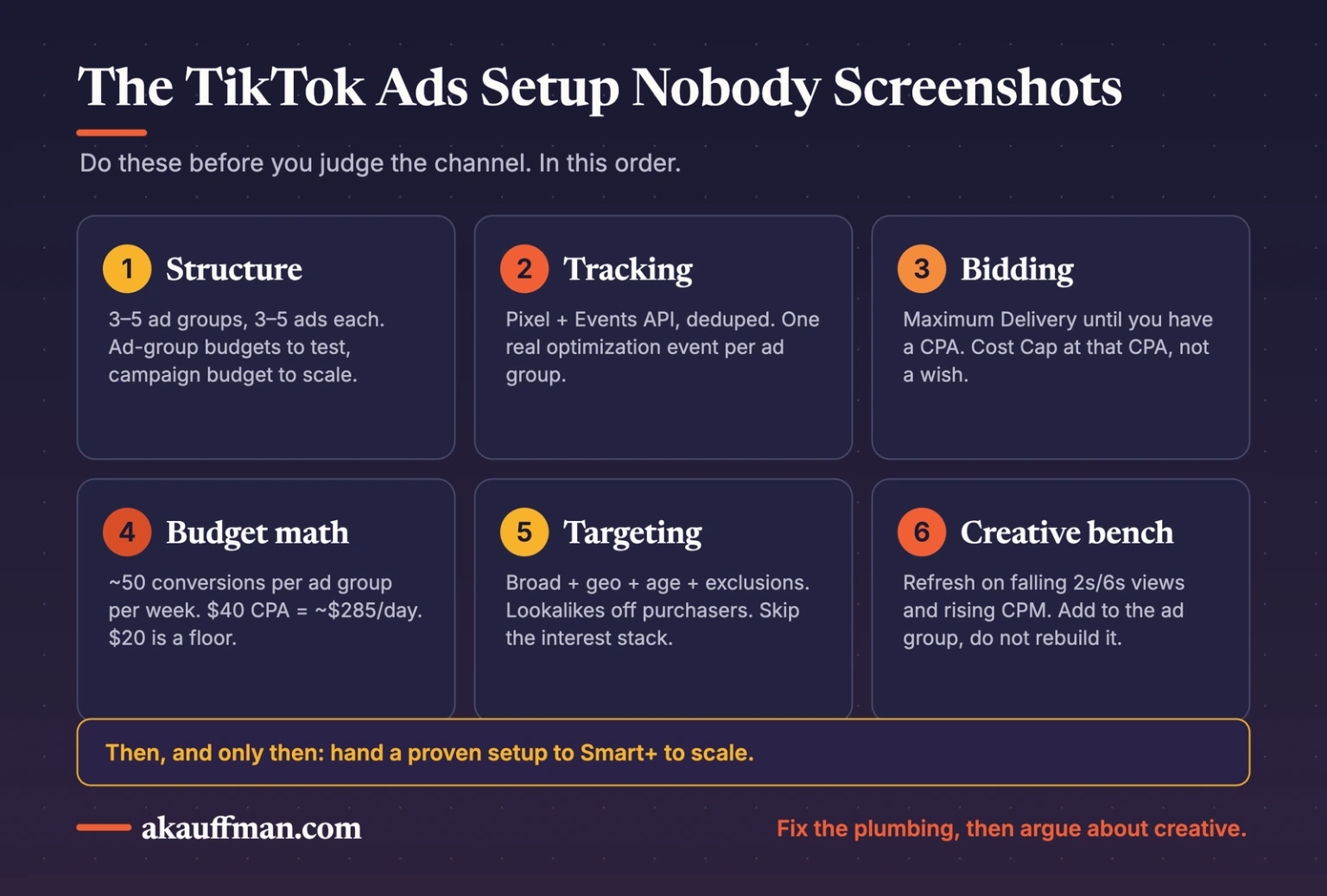
TikTok is three tiers: campaign (objective), ad group (audience, placement, budget, bid, optimization event), ad (creative). Two rules. First, test with ad-group budgets so every audience or angle gets an equal shot, then move proven ad groups into campaign budget optimization to scale. Second, keep it small: three to five ad groups per campaign, three to five ads per ad group. More than that fragments a budget that’s already thin at the ad group level.
2. Tracking: pixel plus Events API, and one event that matters
Install the pixel through your platform integration or Tag Manager, then add the Events API so server-side events survive ad blockers and iOS. Deduplicate with a shared event ID or you’ll double count. Then pick one optimization event per ad group: Complete Payment for ecommerce, a form submit or booked call for lead gen. Optimizing to “View Content” because it has more volume will teach the algorithm to find window shoppers.
Lead-gen note for my home-services clients: TikTok’s instant forms convert well and keep the user in-app, but the lead quality is lower and speed-to-lead matters even more. If you use them, route submissions to your CRM in real time and call within minutes.
3. Bidding: start on Maximum Delivery, earn your way to Cost Cap
New account, new event, or new creative: run Maximum Delivery for the first week or two to establish a real CPA. Once you have a stable number and consistent volume, switch to Cost Cap set at or slightly above that CPA, not at the number you wish it were. Setting a Cost Cap below what the account has ever achieved is the most common reason I see TikTok ad groups that simply won’t spend.
4. Budget math: the learning phase is a volume problem
TikTok’s own documentation says delivery volatility settles after roughly 25 results or seven days, and the working rule of thumb is about 50 conversions per ad group per week to fully exit learning. Run the math. If your CPA is $40, that’s $2,000 a week per ad group, about $285 a day, not the $20 minimum the platform will let you type. If you can’t fund that, use fewer ad groups or optimize to an event higher in the funnel that you can actually buy 50 of. The $20 and $50 minimums are floors, not budgets.
5. Targeting: broad, with guardrails
Age 18+ (or your real floor), your service area or shipping footprint, exclusions for existing customers and recent converters. Add custom audiences from your pixel and customer list, and a lookalike off purchasers once you have a few hundred of them. Skip the interest stack unless you’re in a genuinely niche category. Most of the audience work now happens in the creative.
6. Creative cadence: refresh on signal, not on schedule
Watch frequency and engagement velocity. When 2-second and 6-second view rates start sliding and CPM climbs on the same ad, it’s fatigued. Add new creative into the existing ad group rather than spinning up a new one, which preserves learning. Keep a bench of three to five untested variants ready at all times; the accounts that scale are the ones that never run out of new hooks. Spark Ads from creators or your own organic posts are the cheapest way to keep that bench full.
7. Metrics stack: read them in order
Hook rate (2-second views over impressions), then 6-second view rate, then CTR, then conversion rate, then cost per result, then blended cost per result across all channels. Each layer diagnoses the one below it. Low hook rate is a creative problem. Good hook rate and low CTR is an offer or CTA problem. Good CTR and low conversion rate is a landing page or event problem. Jumping straight to CPA tells you something’s wrong without telling you what.
8. Smart+: turn it on after manual has found the signal
Smart+ automates targeting, bidding and creative selection, and it works, with the same caveat as Advantage+ and Performance Max: it needs conversion volume and creative variety to work with. Use manual campaigns to find the event, the CPA and the winning angles, then hand a proven setup to Smart+ to scale. Handing it a cold account with two videos is how you get an expensive, confident algorithm.
On TikTok, the creative is the part everyone argues about. The setup is the part that decides whether the creative ever gets a fair test.
The balanced take
None of this replaces the creative advice. A perfectly plumbed account running one polished brand video will lose to a sloppy account with a great founder-to-camera clip. But the reverse is also true, and it’s the failure mode I see far more often: good creative, wrong optimization event, Cost Cap set at a fantasy number, three ad groups sharing a budget that couldn’t exit learning for any one of them, and a verdict of “TikTok doesn’t work for us” after three weeks.
My POV
A vendor sells you the creative conversation because it’s the fun one. A partner sits through the boring one first: event mapping, dedupe, budget math, bid strategy, then creative. That order isn’t glamorous, but it’s the order in which the money actually moves.
If you’re deciding whether TikTok belongs in the plan at all, start with whether it’s your storefront or your billboard. If it’s in the plan, this is the setup that gives it a fair shot.
The bottom line
Take the creative advice from the big guides; it’s good. Then do the eight things above before you judge the channel. Broad targeting, one real optimization event, pixel plus Events API, Maximum Delivery until you have a CPA, Cost Cap after, budgets sized to 50 conversions a week, a creative bench, and Smart+ only once the manual setup has proven there’s something to automate.
Related reading: Is TikTok your storefront or your billboard? · On Meta, your creative now determines your target audience
Want a second set of eyes on your TikTok setup?
I’ll audit the structure, tracking, bidding and budget math in an hour and tell you whether the channel has had a fair test. Book a call.