Every few months a client forwards me the same chart: cost-per-click, marching up and to the right, with a one-word question attached — “why?” The instinct is always to look at the auction. Raise the bid, lower the bid, add negatives, tighten match types. But here’s the uncomfortable truth most PPC conversations skip: by the time you’re in the auction, the price is mostly already set. CPC inflation starts before the auction — and if you’re only fighting it at the bid level, you’re bringing a squirt gun to a structural fire.
Search Engine Land’s Ben Wood made this case sharply in a recent piece, and it’s worth building on, because it reframes the entire rising-cost problem. Three layers determine what you pay for a click, and two of them are decided long before Google runs the auction.
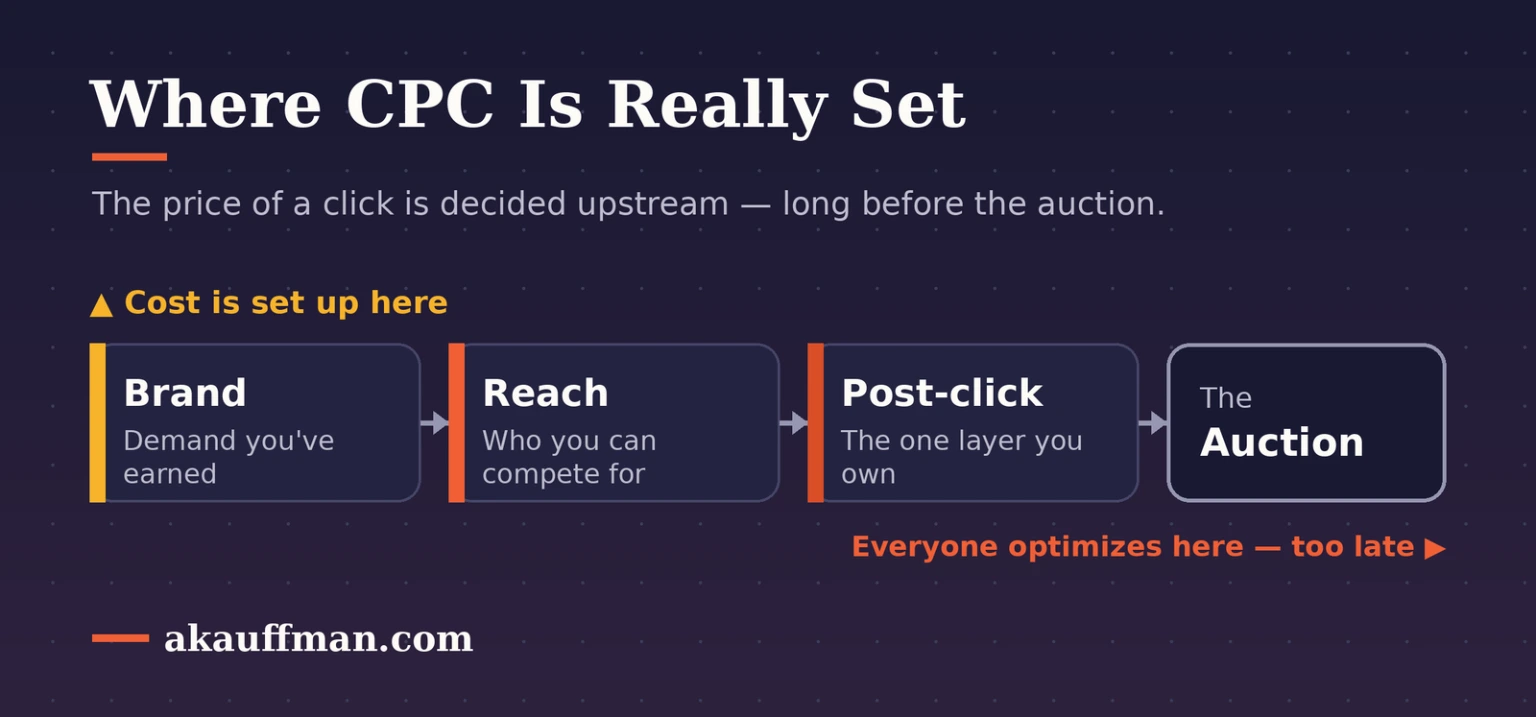
The three layers of what a click costs
1. Brand — demand you’ve already earned
A searcher who already knows and trusts you behaves differently in the auction. They’re likelier to click your ad, likelier to convert after, and that expected behavior feeds your Quality Score and lowers your effective cost. This is why branded search is cheap and why brands with real awareness pay less for the same non-brand keyword than an unknown competitor does. Data backs it: Dreamdata found branded search CPCs still rose ~34% over twelve months — even the cheap traffic is inflating. Brand isn’t a “brand team” line item; it’s a paid-media cost lever.
2. Reach — who you’re allowed to compete for
The audiences you build, the signals you feed Google, and the markets you choose to fight in set the competitive temperature before you ever bid. Chase the same broad, high-intent terms everyone else wants and you’re renting the most expensive real estate on the internet. Reach strategy decides which auctions you even enter — and the smartest advertisers win by entering different ones.
3. Post-click experience — the only layer you fully control
Here’s the lever most accounts underuse: what happens after the click. Landing page experience is one of the three components of Quality Score, and a higher Quality Score directly offsets the need to bid more aggressively. Google’s Ad Rank literally rewards a better post-click experience with a lower cost to show. And beyond the algorithm, your conversion rate decides what each expensive click is actually worth once you’ve paid for it.
Rising CPCs aren’t a bidding problem you solve in the auction. They’re a brand, reach, and conversion problem you solve everywhere else — and then the auction gets cheaper on its own.
My POV: stop optimizing the 20% you can see
Most paid-media work obsesses over the auction because it’s the part with the most buttons — bids, budgets, match types, the Smart Bidding targets I wrote about recently. Those matter. But they’re the last 20% of the cost equation, and they’re the part where you have the least leverage, because you’re fighting every other advertiser on the same battlefield with the same tools.
The 80% you actually control lives outside the auction: are you building branded demand so your name does some of the bidding for you? Are you competing in auctions you can win instead of the ones everyone wants? And is your post-click experience — page speed, message match, mobile UX, the offer itself — doing the work to convert the traffic you already paid a premium for? In an inflating market, conversion rate optimization stops being a quarterly nice-to-have and becomes your primary defense against rising acquisition costs.
What this looks like in practice
Audit the post-click first. Before touching a single bid, pull the landing page experience column and your conversion rates by device. That’s where the cheapest wins hide — a Quality Score bump lowers CPC on every future click for free.
Separate branded demand from the paid-media conversation. If your non-brand CPCs are climbing, the long-term fix is often more brand investment, not more bid. They’re the same budget conversation, and treating them as separate departments is how costs quietly compound.
Measure what’s real, not what shifted. Rising numbers can be demand, competition, or — as I covered with the recent Performance Max reporting change — just a measurement shift. Before you react to a CPC or spend spike, confirm it’s a market signal and not a dashboard artifact.
Give Smart Bidding a better foundation. Automated bidding can only work with what you hand it. Clean conversion tracking, strong Quality Scores, and a defined audience strategy make every automated bid cheaper — the algorithm is optimizing your inputs, not rescuing them.
The bottom line
If your CPCs are rising and your only response is in the bid strategy, you’re managing the symptom. The price of a click is set by everything you did — or didn’t do — before the auction opened: the brand you built, the audiences you chose, and the experience waiting on the other side of the click. That’s not a bidding skill. It’s a full-funnel one. And it’s exactly the difference between an account manager and a marketing partner.
Fighting rising CPCs the hard way?
If your cost-per-click keeps climbing and bidding tweaks aren’t holding the line, the fix is usually upstream — in brand, audience, and conversion. Book a free strategy call and we’ll find the pre-auction levers your account is leaving on the table.