A painting contractor I work with was quietly losing Local Services Ads leads and couldn’t figure out why. His ad was live, his budget was fine, his reviews were strong. But his lead flow had been sliding for two months. When we dug in, the answer wasn’t in his ad settings at all — it was his Google Business Profile. He’d treated it like a listing he finished setting up in 2022. Meanwhile Google had quietly turned that profile into the engine behind almost everything a homeowner uses to find him.
If you run a home-service business — construction, painting, HVAC, plumbing, electrical — here’s the shift that matters: your Google Business Profile is no longer one marketing channel. It’s the shared engine behind three of them at once. The map pack, your Local Services Ads, and the new AI answers all draw from the same profile. Neglect it and you don’t lose one door. You lose all three simultaneously — and you usually can’t see it happening.
A recent Search Engine Journal rundown laid out the new GBP playbook for local search. It’s solid — but it’s written for every local business. For contractors running paid Local Services Ads, the stakes are higher and the mechanics are different. Here’s the version I give my home-service clients.
One profile, three front doors
Start with the picture, because it reframes everything. The same profile signals — reviews, photos, posts, hours, service list — now feed three separate ways a homeowner lands on you.
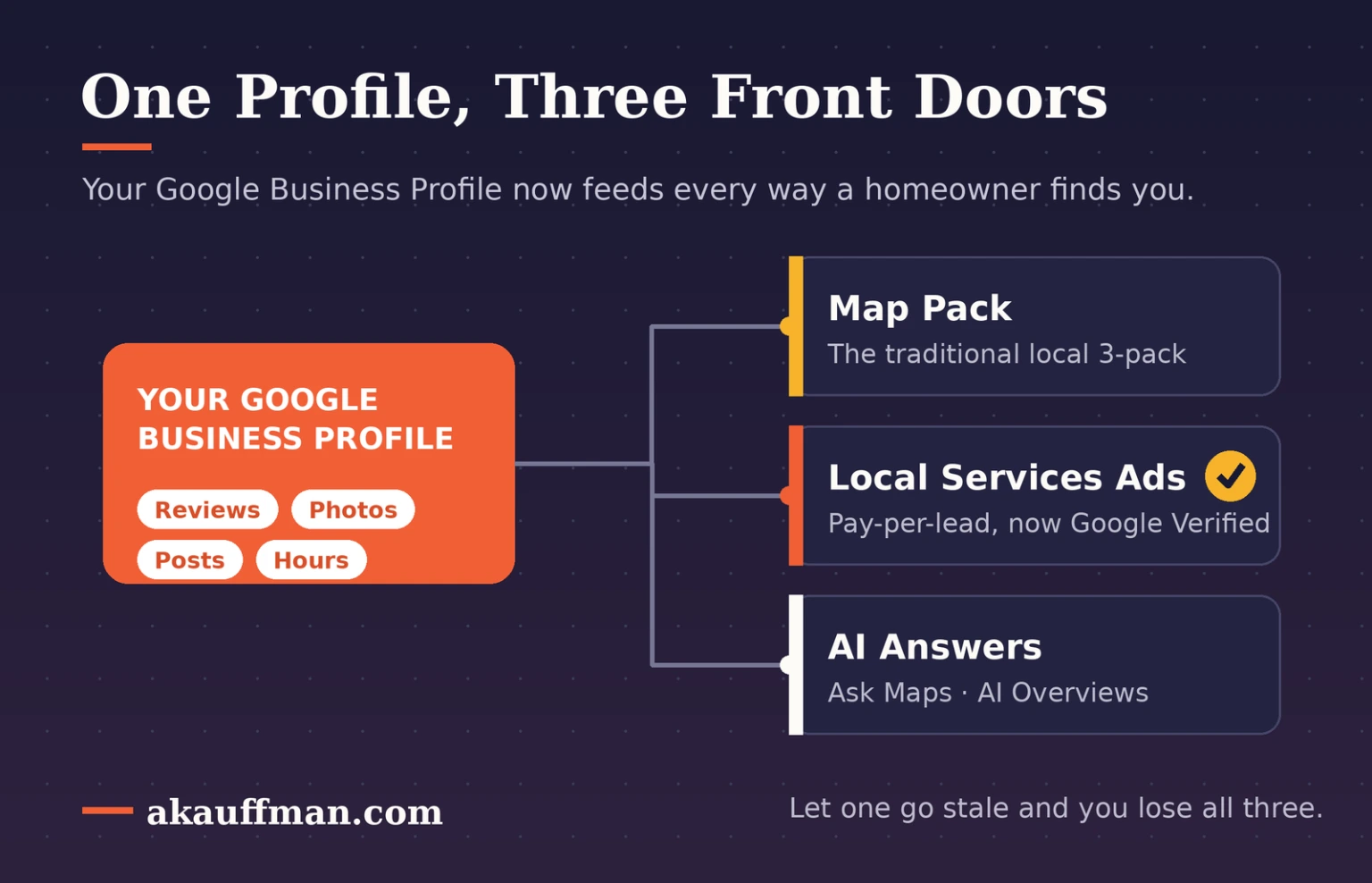
The map pack you already know. The other two are where the new money is: the Local Services Ads unit at the very top of the page, and the AI answer a homeowner now gets when they ask Google, ChatGPT, or Gemini “who should I call.” All three read from the profile you may not have touched in a year.
What actually changed (and why LSA makes it urgent)
Two shifts turned GBP from a set-and-forget listing into an operating discipline for contractors specifically.
1. Your Google reviews are now your LSA reviews
This is the big one most contractors miss. As of mid-2025, there’s no separate Local Services Ads review system — your Google Business Profile reviews are your LSA reviews, and a verified, linked GBP is required just to run the ads. That means the reviews driving your organic map pack rank are the exact same reviews deciding whether your paid LSA shows up first or fourth. One asset, two channels. A stale review profile doesn’t just hurt your free rankings anymore — it’s actively throttling the ads you’re paying for.
2. The badge got simpler — so trust is now table stakes
On October 20, 2025, Google retired the old Google Guaranteed, Google Screened, and License Verified badges and folded them into a single “Google Verified” blue checkmark (the money-back guarantee went away with them). Sounds minor. It isn’t. When every contractor in the unit carries the identical check, the badge stops being a differentiator. Homeowners can no longer tell you apart by trust marks — so the decision moves entirely to what’s on your profile: your review count, your recency, your photos, your responsiveness. The exact signals a neglected profile is weakest on.
Your reviews are doing double duty now — ranking your map listing and ranking the ads you pay for. A profile you set up once is quietly costing you on both.
Why this hits home services harder than anyone
Home-service demand is the definition of high intent. Nobody researches a burst pipe. They search “who can fix this right now,” and Google’s newer surfaces are built exactly for that moment — its Ask Maps feature answers multi-condition questions like “emergency plumber open now near me” by pulling live profile data: your hours, your service list, your reviews. Being open when someone searches is now one of the top local ranking factors on its own. A wrong holiday hour isn’t a nuisance; it’s you disappearing during the exact window a homeowner is ready to pay.
And the AI layer is moving fast. BrightLocal’s 2026 consumer research found roughly 45% of people now use AI tools to find local businesses — up from single digits a year earlier. Yet one 2026 index of HVAC and plumbing brands found that nearly nine in ten independent contractors have effectively zero presence in AI answers for their own market — including businesses with hundreds of five-star reviews and decades in town. The homeowner asks the AI; the AI recommends a national brand or a competitor who kept their profile alive. This is the same “get cited, not just ranked” problem I wrote about with AI Overviews and local citations — it just bites contractors first and hardest.
The contractor’s GBP playbook (in priority order)
1. Build review velocity into the job, not the office
Volume and recency beat a slightly higher star average — a company with steady fresh reviews outranks an older company with more but staler ones, in both the map pack and LSA. Ask on-site, the day the job wraps, while the driveway still looks new. Automate the request through your CRM or field-service app so it fires within 24 hours. And coach for specific language: a review that says “exterior repaint, on time, spotless cleanup” ranks you for those searches far better than “great job.” Respond to every review inside a couple of days — that’s a live engagement signal too.
2. Answer fast — responsiveness is an LSA ranking factor
Google watches how quickly and consistently you respond to LSA leads. Miss calls, let messages sit, and your ad ranking slides regardless of your review count. For a contractor in the field all day this is an operations problem, not a marketing one: set up call-answering or a fast callback process so leads don’t rot. The businesses winning LSA aren’t always the biggest — they’re the most responsive.
3. Photos: job sites and before/afters, uploaded steadily
Freshness beats a big stale library. Eighty photos from three years ago send a worse signal than a handful uploaded this month. For trades this is easy and high-value: real before/after shots, crews on site, finished work. Authentic beats stock every time, and it’s exactly the imagery AI systems and homeowners trust. Put “take two photos” on every job checklist.
4. Guard your hours like a ranking field — because it is
Audit hours quarterly and set holiday and special hours before the date, not after. If you offer 24/7 emergency service, make sure the profile actually says so and is structured correctly — that’s what lets you surface for “open now” and emergency queries where the margins live.
5. Post weekly and turn on messaging, booking, and Q&A
A weekly post — a finished project, a seasonal offer, a service reminder — is the most underused freshness signal there is. Then seed your Q&A with the five questions every homeowner actually asks (“are you licensed and insured,” “do you offer free estimates”) and answer them yourself before a stranger does. Enable messaging and any booking link your business supports; every real interaction tells Google the profile is live and driving action.
Measure it before you optimize it
Here’s the trap I see contractors fall into: they pour effort into “showing up in AI” without any way to know if it’s working. AI-driven calls almost always hide inside “direct” or “unattributed” traffic. Before you spend on optimization, get call tracking in place so you can actually see which calls came from the map pack, from LSA, and from AI. You can’t manage a channel you refuse to measure — and for a home-service business, the phone is the conversion.
My POV: a contractor’s profile is now an operating discipline
The vendor who “set up your Local Services Ads” did a one-time technical task and moved on. But the new reality isn’t technical — it’s operational. Review velocity, response time, weekly photos, accurate hours: that’s a weekly rhythm run through your crews and your phone, not a settings screen you visit once. Most contractors won’t sustain it, which is precisely why it’s a moat for the ones who do. And because it’s the same profile feeding all three doors, every bit of that work compounds across your rankings, your ads, and your AI visibility at the same time. That’s the whole argument for treating your GBP as a living channel — I made the general case in the dynamic GBP playbook; this is what it looks like when there’s a paid LSA budget riding on top of it. Setting up the profile is a vendor’s job. Running the engine that keeps it alive is a partner’s.
The bottom line
For home-service contractors, the static Google Business Profile is dead twice over: it costs you free map pack rankings and throttles the Local Services Ads you’re paying for, while the AI answer quietly recommends someone else. One profile now runs three front doors. Feed it — reviews on a cadence, fast responses, fresh job photos, accurate hours, weekly posts — and all three open at once. Let it go stale and they close together, usually before you notice the phone got quiet.
Is your profile working all three doors?
If you’re running Local Services Ads on a profile you set up years ago — or you’re not sure whether AI is sending homeowners to you or your competitors — book a free strategy call and we’ll pressure-test your map pack, your LSA, and your AI visibility together.