A prospect forwarded me a “14 Meta Ads best practices” checklist last week and asked which ones we’d be doing. Honest answer: about half of it is fine, and about half of it is 2019 advice that Meta’s own automation has quietly made irrelevant. Carousel formatting tips, copy tweaks, “keep up with trends” — none of it is wrong. It’s just not where performance comes from anymore.
Here’s the reframe. As of this year, Advantage+ isn’t a feature you opt into — it is the campaign. In February, Meta merged the manual and Advantage+ creation flows into a single builder, so AI optimization now applies to nearly every campaign you launch. Andromeda picks the audience. Advantage+ picks placements and spins up creative variants. The machine runs the campaign. Which means “best practices” in 2026 boil down to one thing: the inputs and guardrails you still own. There are eight. (If you want the exhaustive version, LeadsBridge’s 14-point rundown is a thorough one — this is the condensed, 2026-weighted cut.)
What actually changed — and why the old list aged out
Three shifts did the damage to the classic checklist. First, Andromeda turned Meta from an audience-first system into a creative-first one — the AI reads your ad and finds the people for it, which is why I’ve argued your creative now determines your target audience. Second, Meta collapsed most of the granular interest categories into broad groupings and removed detailed-targeting exclusions entirely, so the surgical audience-building the old lists loved simply isn’t there to do. Third, in March Meta changed attribution: click-through now counts only true ad-link clicks, with likes, shares, saves and video taps moved to a separate engage-through bucket — so any benchmark you set before spring is measuring something different.
To be fair to Meta: this is mostly good. Broad targeting plus Advantage+ beats interest-stacking in the large majority of accounts I see, and the tooling is better than the manual version it replaced. The trap isn’t the automation. It’s treating “default” as “done.”
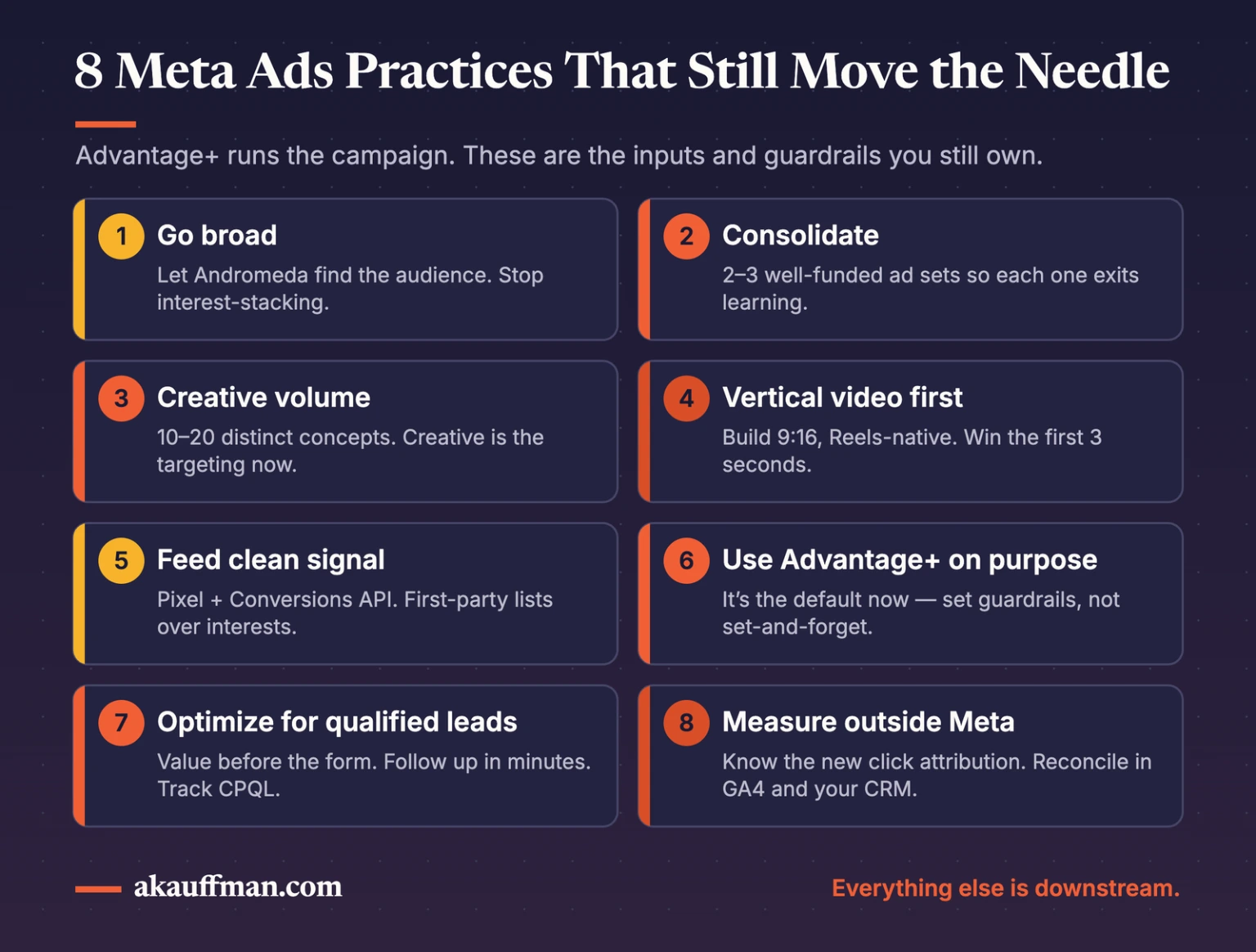
The eight that still move the needle
1. Go broad and let Andromeda do the targeting
Stop stacking interests. Give the system a broad audience (or Advantage+ audience with a light suggestion) and let it find buyers off your creative and your conversion signal. Your job shifts from picking the audience to informing it — which is what practices three and five are about.
2. Consolidate so the algorithm can actually learn
The most common structural mistake I inherit is fragmentation: fifteen ad sets at $20 a day, none of which will ever exit the learning phase. Meta’s guidance is roughly 50 optimization events per ad set per week (it has lowered that bar for some purchase-optimized campaigns), and you only get there by consolidating into two or three well-funded ad sets and letting the system optimize across the pool.
3. Treat creative volume as the media plan
If creative is the targeting, then creative production is media buying. Feed the system 10–20 genuinely distinct concepts, not five tweaks of one image, and refresh before fatigue sets in — Meta treats near-identical assets as the same ad. Judge them on hook rate and hold rate first, conversions second; I broke that down in the creative-metrics ladder.
4. Build vertical video first
Design for 9:16 and Reels-native, not repurposed from landscape. Assume sound-off, caption everything, and win the first three seconds — that’s the wall Andromeda uses to decide whether your ad keeps getting delivered.
5. Feed the machine clean signal
Run the Pixel and the Conversions API. Every event you don’t send server-side is signal the algorithm isn’t learning from, and in 2026 that’s the difference between a campaign that scales and one that stalls. Lean on your own first-party lists before any interest category, and keep your event match quality high.
6. Use Advantage+ on purpose, not by default
Because Advantage+ is now the default flow, most accounts are running automation they never consciously chose: expanded audiences, automatic placements, AI-generated creative enhancements. Know exactly what’s switched on, set brand guardrails where it matters (regulated industries especially), and keep the same discipline I apply to Google’s recommendations: a platform default serves the platform’s model until you make it a decision.
7. Optimize lead ads for qualified leads, not cheap ones
For lead-gen, the cheapest lead is usually the worst one. Show the value before the form, add deliberate friction (a qualifying question or two), follow up within minutes not hours, and measure cost per qualified lead rather than cost per lead. Volume that your sales team can’t close is just a bill.
8. Measure outside Meta — and know the new rules
Meta’s attribution is generous to itself, and after the March click-through change it’s also different from what your historical reports were built on. Tag your URLs, reconcile in GA4 and your CRM, and hold the account to numbers Meta doesn’t control — the same grounded-in-real-math standard I use for every paid channel.
In 2026 the algorithm isn’t competing with you for control. It’s working for you — and it’s exactly as good as what you feed it.
What I’d stop obsessing over
Carousel micro-formatting. Copy hacks. Manually toggling placements. Chasing whatever format is trending this month. None of it is useless, but all of it is downstream of the eight above — and every hour spent there is an hour not spent producing the next ten creative concepts or fixing your conversion signal. Do it last, if at all.
My POV: run the system, not the checklist
A vendor works the 14-point checklist and reports activity: placements optimized, copy refreshed, trends followed. A partner runs the system — feeds the machine clean signal and real creative volume, holds the guardrails, and measures the whole thing outside the platform. In a world where Meta genuinely runs the campaign, that’s the entire job, and it’s the difference between an account that compounds and one that plateaus at “fine.”
The bottom line
Advantage+ runs the campaign now. Your leverage is the eight inputs it depends on: broad targeting, a consolidated structure, real creative volume, vertical video, clean signal, deliberate automation, qualified-lead optimization, and measurement Meta doesn’t control. Nail those and the rest of the checklist takes care of itself. Skip them and no amount of carousel polish will save the account.
Want a second set of eyes on your Meta setup?
Book a free strategy call and we’ll audit your account against these eight — and tell you which of the other fourteen you can safely stop worrying about.