Ask ten advertisers where their target ROAS came from and you’ll get ten confident answers and maybe two correct ones. “That’s what we’ve always used.” “The agency set it.” “It felt right.” Here’s the uncomfortable truth: for most accounts, the single most important number in the whole system — the target you hand your bid strategy — is a guess wearing a suit. And a new Search Engine Land piece from Wijnand Meijer lays out the health check almost nobody actually runs.
The health check, in one line
Your bid strategy is only as good as the target behind it. Target CPA and Target ROAS don’t find profit — they optimize toward a number you gave them. If that number isn’t tied to your actual margins, Smart Bidding will hit it beautifully and lose you money with great efficiency. The 4-step check is really one question asked four ways: is this target grounded in the business, or in habit?
Start where every target should start: break-even
Before you can set a good target, you need your break-even — the point where an extra sale neither makes nor loses money. The math is unglamorous and non-negotiable:
Break-even ROAS = 1 ÷ profit margin. A 40% margin means a break-even ROAS of 2.5 (1 ÷ 0.40). Spend that gets you 2.5x revenue is a wash; anything below it is you paying customers to buy from you. For lead gen, the CPA version is the same idea: your break-even CPA is the margin you earn per converted customer. If you don’t know this number cold, you’re not optimizing — you’re gambling with a confident-looking dashboard.
Then you build in a buffer. Your real target should sit above break-even — typically 20–50% higher — to absorb the things the platform never tells you about: returns, refunds, attribution error, and seasonality. A break-even ROAS of 2.5 might mean a working target of 3.5–4x. That gap is your profit and your margin for being wrong.
The trap: platform ROAS is not your ROAS
Here’s the part that quietly wrecks accounts. The ROAS in your Google Ads dashboard is reported ROAS — built on last-click-ish, platform-favorable attribution. Your blended ROAS — total revenue divided by total ad spend, the number your bank account actually feels — is almost always lower. A campaign showing a triumphant 6x on-platform can be running a 3x in reality. Set your target off the pretty number and you’ve baked the attribution gap straight into your bidding.
Target ROAS and CPA don’t find profit. They optimize toward the number you give them — so the number had better be true.
This is exactly why the health check matters more now than it did six months ago. As I covered in the Smart Bidding “true target” update, starting August 17 Google enforces your stated target across the full budget instead of quietly letting campaigns over-deliver. Translation: a wrong target used to be softened by the algorithm holding back. Now it gets executed faithfully. The cost of a lazy target just went up.
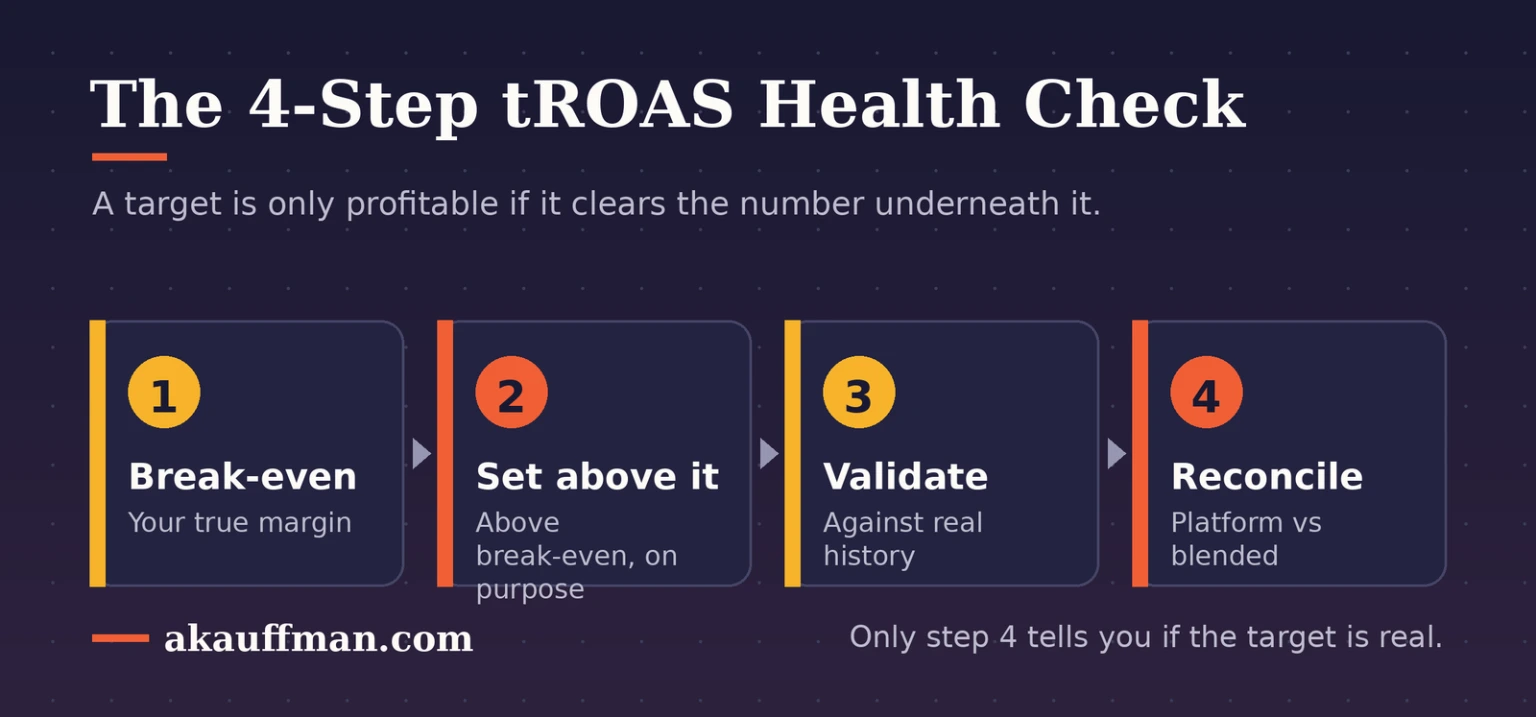
Run the check (in this order)
1. Calculate your true break-even
Get your real gross margin from finance, not from a guess. Break-even ROAS = 1 ÷ margin. Break-even CPA = margin per conversion. Write it down. This is the floor everything else stands on.
2. Set the target above break-even, on purpose
Add a deliberate buffer for returns, attribution slippage, and seasonality — 20–50% above break-even is a sane starting band. The exact number is a business decision about how much growth you’ll trade for how much margin, not a dial you nudge until the graph looks nice.
3. Validate against real campaign history
Pull your trailing 28-day actual ROAS/CPA and compare it to the target you’re about to set. If your target is wildly detached from what the account has ever delivered, Smart Bidding will either choke on volume or blow past your economics. Reality is a constraint, not a suggestion.
4. Reconcile platform vs. blended
Divide total revenue by total ad spend for the period and compare it to your on-platform ROAS. The gap between them is your attribution inflation — discount your platform targets by roughly that much so you’re optimizing toward the profit you actually keep.
My POV: the target is a business decision, not a bidding setting
The whole industry treats the target as something you tune inside the ad platform, next to the bids and budgets. That’s the mistake. The target is where your marketing meets your P&L — it’s a finance number that happens to live in an ad account. Anyone can turn Target ROAS on. Knowing what the target should be — and being able to defend it with margin math and blended data — is the part that separates someone renting you a platform from someone accountable for your profit.
It also connects to a bigger pattern I keep coming back to: rising costs are rarely solved in the auction. Whether it’s CPC inflation that starts before the bid or a target that was never grounded in margin, the leverage is almost always upstream of the buttons everyone fixates on.
The bottom line
If you can’t tell me your break-even ROAS in one sentence, your target isn’t a strategy — it’s a placeholder, and Smart Bidding is faithfully optimizing toward a placeholder. Run the four-step check, ground the number in real margins and blended data, and you turn your bid strategy from a hopeful guess into an actual profit engine.
Not sure your targets are grounded in reality?
If your Target ROAS or CPA was set by habit rather than margin math — or you’ve never reconciled platform numbers against blended — book a free strategy call and we’ll pressure-test the number your whole account is optimizing toward.