A store owner I work with was proud of one Shopping campaign in particular. Capped budget, and it printed a 600% ROAS month after month while everything else hovered near target. He thought it was his best-optimized campaign. It wasn’t. The budget cap was the hero, not the bidding — and on August 17, Google is quietly retiring that hero.
Here’s the reframe every ecommerce advertiser needs before that date: if you run Target CPA or Target ROAS and any campaign sits at “Limited by budget,” the fact that it beats its target isn’t a bidding miracle. The cap was doing the work. Google’s August 17 target-based bidding change hands that free efficiency back to the algorithm — and for thin-margin stores, that can quietly erase the profit you thought you were printing.
What actually changes on August 17
Today, a budget-limited Target CPA or Target ROAS campaign often beats its target. After August 17, Google optimizes so actual performance tracks toward the target you set instead of overshooting it. Take a $100 target CPA campaign that’s been delivering at $50 — it will move toward $100. A 400% ROAS target while the campaign quietly runs at 600% will drift down toward 400%. Same idea, opposite direction.
Three things make this urgent. It’s automatic, not opt-in, on eligible campaigns across Search, Shopping, Performance Max, Demand Gen, Travel, and Display (App and Video are excluded). Google has said it will not adjust your targets or budgets for you. And the runway is short: the Bid Target Adjustment Tool went live July 6, account notifications are landing now, and the change starts rolling out August 17. Confirm the details in Google’s own documentation.
The mechanism: why budget-limited campaigns overdeliver
This is the part most coverage skips, and it’s the whole game. When a campaign is limited by budget, the cap — not the target — is the real constraint. The algorithm never spends all the way up to the target; it buys the cheapest conversions it can inside the cap and leaves the rest of the target headroom untouched. That gap between your $50 actual and your $100 ceiling was efficiency you were getting for free, because budget was doing the limiting.
After August 17, the system treats that headroom as room to work with. It pursues additional conversions that cost more, which pulls your average up toward the target you entered. Your target stops being a ceiling you rarely touched and becomes a destination the algorithm actively aims for. It’s the same shift I unpacked in how your Target CPA becomes a contract — this piece is what that means specifically for a store running Shopping and Performance Max on a capped budget.
Give Google its due — then read the trap
To be fair: this is defensible, and Google has been clear about the framing. Ads Liaison Ginny Marvin has pushed back on the idea that this is Google telling you to spend more; it doesn’t touch your budgets or settings, and it does make performance more predictable as you scale, which is a real benefit. Targets are meant to be your lever for efficiency; Maximize Conversions and Maximize Conversion Value are the tools for a fixed budget with no target.
Now the trap. The real risk isn’t the change — it’s a target you set once as a rough ceiling and never revisited, because the campaign beat it every month anyway. If your $100 CPA was aspirational rather than a real break-even number, or your 400% ROAS was a placeholder while the campaign ran at 600%, August 17 turns that placeholder into a live target. On a thin-margin catalog, the drift toward it spends real money on the marginal conversion.
On a thin-margin catalog, the drift toward target doesn’t cost you a rounding error — it spends the profit you thought the campaign was printing.
The honest call for each budget-limited campaign
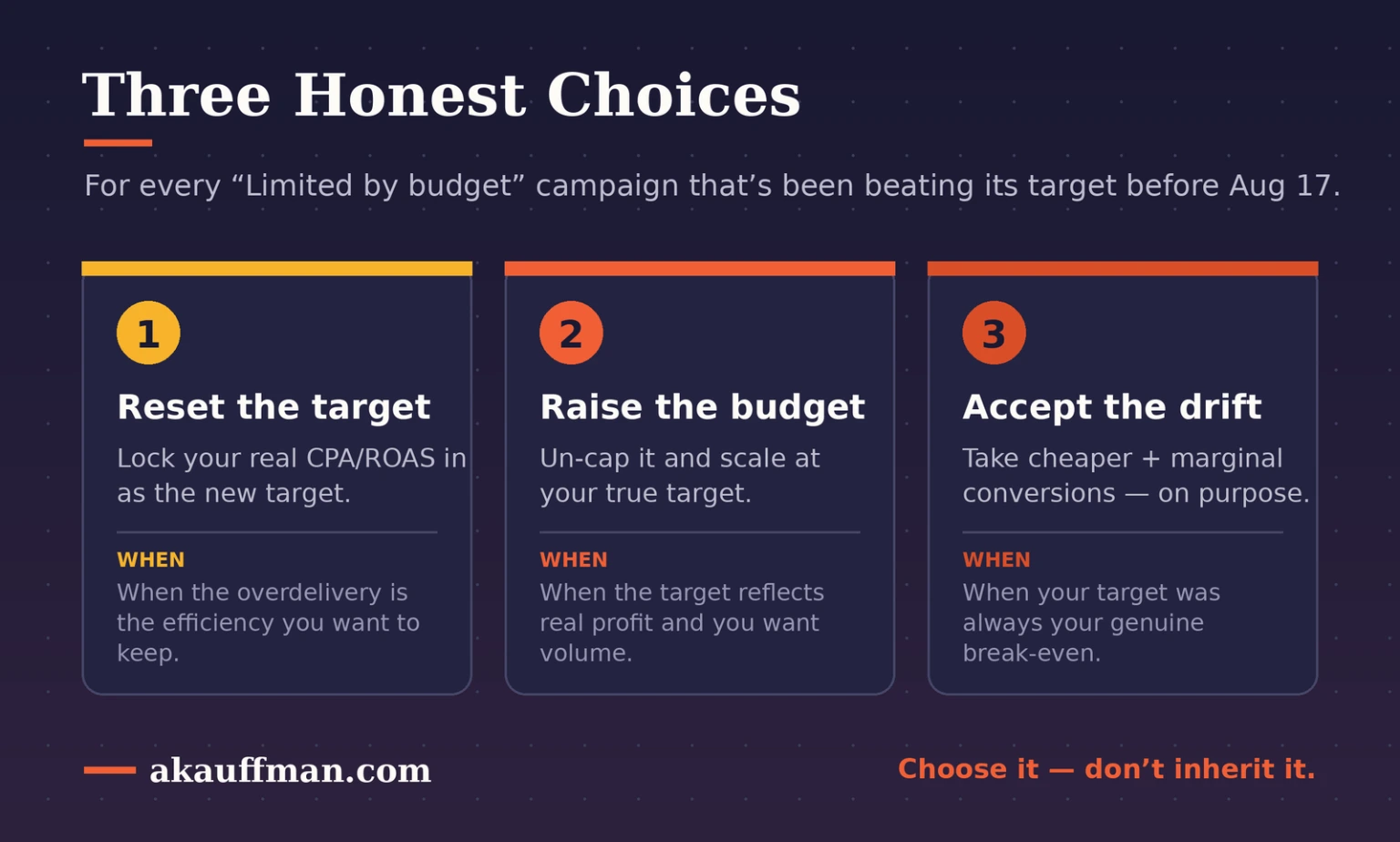
For every campaign that’s limited by budget and sitting comfortably inside its target, you have three legitimate options. The point is to choose one, not inherit the drift because you forgot to look.
1. Reset the target to your actual performance
If a campaign has run at a $50 CPA or 600% ROAS and that’s the efficiency you want to keep, update the target to match before August 17. The Bid Target Adjustment Tool can apply your recent performance as the new target in a couple of clicks, which holds your current numbers in place.
2. Raise the budget and scale at your true target
If the overdelivery was really a sign the campaign could spend more, lift the budget so it’s no longer limited, and let it capture more volume at your genuine target. This is the growth path — but it only works if the stated target reflects real profitability.
3. Accept the drift — on purpose
If your stated target was always your true break-even and you’re happy to take cheaper conversions and the extra volume, let it drift. Just decide it deliberately rather than discovering it in next month’s report.
4. Rebuild your ROAS floor from contribution margin
The through-line for all three is a target grounded in real business math. Before August 17, set your ROAS floor from contribution margin, not a round number someone typed in a year ago — that’s exactly the exercise in my Target ROAS health check. A target that clears break-even is the only kind this change can’t hurt you with.
5. Watch your Performance Max channel mix
Because Performance Max spreads across Search, Shopping, YouTube and more, Google has said you may see traffic shift between channels as the system rebalances toward the target. Watch channel-level reports in the weeks after the change so a move toward cheaper, lower-intent inventory doesn’t slip past you — and keep the recent PMax reporting change in mind so you’re reading the right numbers.
6. If you want more volume, buy it deliberately
If your honest reaction is “I’d take more volume,” there’s now a purpose-built lever instead of letting the drift spend your headroom at random. Smart Bidding Exploration lets you set a ROAS tolerance (a 5–30% band below your target) so the algorithm can bid on converting queries it would normally skip. Google’s own testing reported roughly an 18% lift in unique converting query categories and a 19% lift in conversions — those are Google’s figures, so treat them as directional. It’s globally available for Performance Max without feeds and in beta for Shopping and PMax with feeds. Google also launched Promotion Mode in beta for a defined peak window, which is worth a look for flash sales heading into Q4.
My POV: this rewards the operator, not the set-and-forget vendor
August 17 rewards exactly one discipline — running targets that reflect real business math instead of placeholders. That sounds obvious, but it’s precisely the work that gets skipped. A vendor lets the default happen and explains the cost increase in next month’s report, after the fact. A partner pulls the budget-limited campaigns this week, checks actual against target, and makes the number honest before the system settles it for you. That’s the difference between a vendor and a partner, and this change turns every stale ceiling into a live test of which one you hired.
The bottom line
The accounts that get caught out on August 17 will be the ones that treated bid targets as set-and-forget ceilings — and a huge share of those are small and midsize stores running “Limited by budget.” Pull every budget-capped Target CPA and Target ROAS campaign, compare 90 days of actual to target, and make the call per campaign: reset, raise the budget, or accept the drift. Do it before the algorithm makes the call for you.
Want a second set of eyes before August 17?
If you run ecommerce campaigns on Target CPA or Target ROAS and you’re not sure which of them are about to move, book a free strategy call and we’ll audit your budget-limited campaigns and set targets that reflect your real margins — before the change does it for you.