A client called me a few months ago thrilled: after a push on their Google Business Profile, they’d climbed into the top three of the map pack for their main service. Real estate you can’t buy. Then, a beat later, the quieter part: “So… why hasn’t the phone really picked up?” Their visibility had jumped. Their leads hadn’t. And that gap — between showing up and getting called — is the most expensive, least-talked-about problem in local search.
Here’s the uncomfortable reframe: a Google Maps ranking is a vanity metric until it produces a call, a booking, or a form fill. Almost every “rank higher on Maps” guide — and, frankly, a lot of agencies — stops at being seen. But being seen is the start of the job, not the finish. The leads live in the conversion path that sits below your ranking, and that path is where the money leaks out.
Visibility is a number. Leads are the job.
A ranking measures how many people could find you. It says nothing about how many chose you, contacted you, or booked. Google itself splits this in your profile data: the Views section counts how many people saw you; the Interactions section counts calls, direction requests, and website clicks. Guess which set pays your bills. You can win the first number and lose the second — and most businesses never look past the first because it’s the one that feels like winning.
The map-to-lead funnel
Think of local search as a funnel, not a scoreboard. Ranking fills the top. Everything beneath it is a series of steps where a prospective customer either converts or quietly drops off — and each step has a specific lever you control.
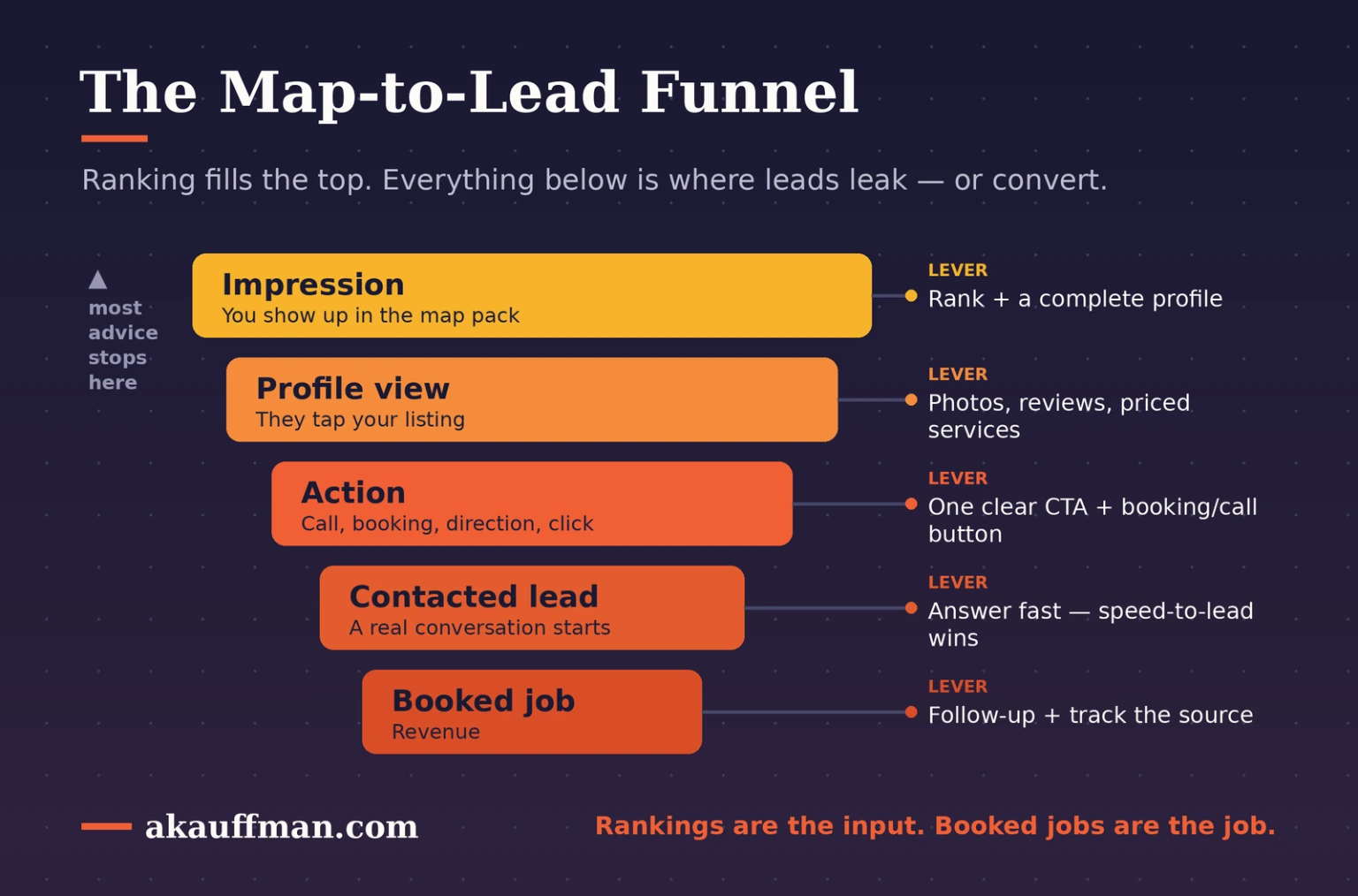
Most owners pour all their attention into the very top of this funnel — the ranking — and never look at the drop-off between a profile view and an actual action, or between a phone call and a booked job. That’s backwards. A modest ranking that converts cleanly will out-earn a #1 pin that leaks at every stage. Here’s how to plug the leaks, in the order they cost you.
Turn each leak into a lever
1. Make your profile a conversion asset, not a directory entry
Your profile is a landing page, so treat it like one. List your services with real descriptions and prices, use photos that sell the outcome (a contractor’s before-and-after, a restaurant’s actual dining room, a clinic’s real team), and seed the Q&A with the questions that decide the sale — “are you licensed and insured,” “do you offer free estimates,” “do you take my insurance.” A complete, persuasive profile is also what keeps you visible in the first place, which I covered in why your GBP is a live channel, not a listing.
2. Treat reviews as the tie-breaker, not just a ranking factor
When two businesses both show up, recent reviews and thoughtful owner responses decide who gets the call. A wall of five-star reviews from three years ago loses to a steady drip of fresh ones. Ask at the moment of delight — the day the job’s done, the meal ends, the results come back — and respond to every review so the next reader sees a business that’s paying attention.
3. Remove the friction to act
Someone searching “plumber near me” or “dentist open now” is in decision mode, not research mode. If acting takes more than a tap, you lose them to whoever made it easy. Turn on the call button, enable messaging, and connect a booking link. Every feature you leave off is a door you’ve locked. This is the same profile-as-engine idea behind the three front doors a local profile now feeds.
4. Answer fast — speed-to-lead is the silent killer
This is where the biggest leak hides, and almost nobody measures it. A missed call in a service business isn’t a missed call — it’s a lead handed to the next result on the list. Whoever answers first usually wins the job. If you can’t answer live, set up a fast callback or texting process, because a two-hour response to a “can you come today” search is a no.
5. Match the click to the promise
If someone taps through from a “water heater repair” search, don’t drop them on a generic homepage and make them hunt. Send them to a page that continues the exact promise they clicked — the service, the area, the proof, and one obvious next step. A mismatch here quietly wastes every click you fought to earn.
6. Measure the whole path, not just the pin
You can’t fix a leak you can’t see. Use call tracking, watch the Interactions in your profile’s Performance data (Google now even attributes actions across classic Maps, Maps AI summaries, and Search), and learn your real conversion rates — view-to-call and call-to-booked. If 100 profile visits produce two bookings, the fix probably isn’t a higher ranking; it’s the funnel underneath. That measurement-first discipline is the same one I apply to paid targets grounded in real business math.
A #1 ranking that doesn’t ring the phone isn’t a win. It’s a very visible way to be ignored.
My POV: rankings are the input, booked jobs are the job
Here’s the tell that separates a vendor from a partner. A vendor sends you a screenshot of your map ranking and calls it a result. A partner treats the ranking as the input it actually is, and holds themselves accountable to the number that matters — booked jobs — by working the entire funnel and measuring where it leaks. Ranking is genuinely valuable; it gets you into the consideration set. But it’s the first step of the job, and anyone who sells it as the finish line is selling you a vanity metric.
The bottom line
Visibility gets you seen; the funnel below your ranking decides whether you get hired. Before you spend another dollar chasing a higher pin, walk your own map-to-lead path and find the leak: is your profile persuasive, is acting frictionless, do you answer fast, does the click land somewhere that converts, and are you even measuring it? Fix the leak, and the ranking you already have will start paying you back.
Ranking but not ringing?
If you’re showing up on Google Maps but the leads aren’t following, book a free strategy call and we’ll map your funnel end to end — and fix the step that’s quietly costing you the calls.