A “mandatory service announcement” landed in my inbox from Google this week, and the subject line is worth reading twice: automatically created assets and campaign-level broad match setting will be upgraded to AI Max. Not could be. Not you’re invited to try. Will be — on September 1, 2026, unless you do something about it first. If you’ve been wondering where Google Ads is actually headed, this email is the clearest answer yet: toward AI by default, and opt-out by design.
AI Max for Search is Google’s successor to Dynamic Search Ads, and it’s officially out of beta. The upgrade itself isn’t the problem — the default is. This is the same pattern I wrote about with auto-apply and the optimization score: Google keeps shifting the starting position from your control to its own, and calling it an upgrade.
First, the part everyone is getting wrong: it’s not one date
Most of the coverage lumps this into a single “DSA is dead in September” headline. That’s not what’s happening. Google split the timeline — and which bucket your campaigns fall into changes what you need to do and when.
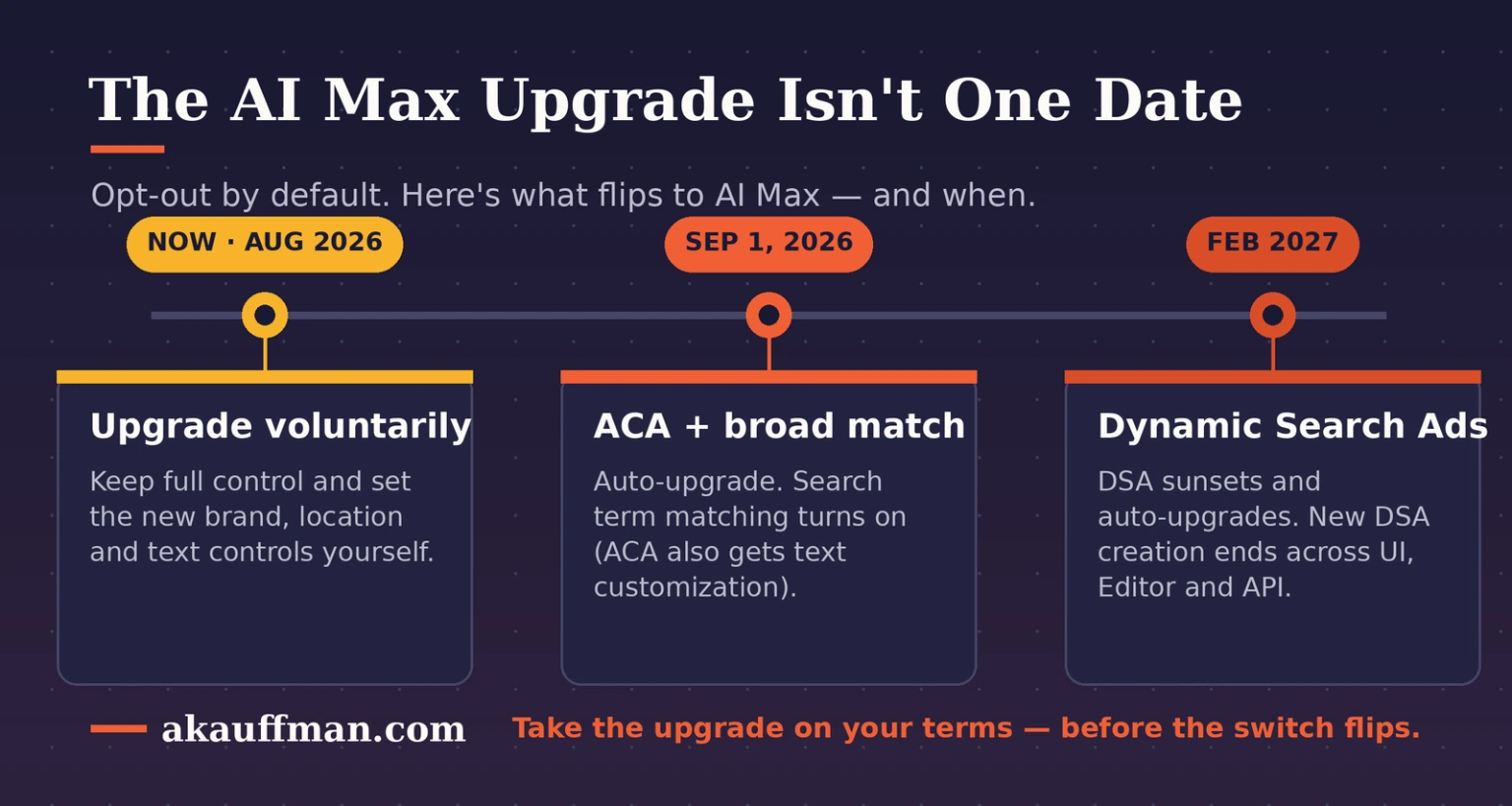
Here’s the plain-English version. If you run automatically created assets (ACA) or the campaign-level broad match setting, you’re in the September 1, 2026 wave — that’s the email I got, and probably you too. If you run classic Dynamic Search Ads, Google heard the feedback and pushed your forced upgrade all the way to February 2027. Same destination, very different deadlines. Don’t let a DSA headline lull you into missing a September deadline for a different feature.
What AI Max actually turns on
AI Max keeps what DSA did — generating relevant headlines and matching to queries beyond your keywords — but it pulls in broader, real-time intent signals to find more of them. Three features do the work, and it’s worth knowing exactly what each one hands to Google: search term matching (keyword-less query expansion), text customization (AI writes and rewrites your headlines and descriptions), and final URL expansion (AI can send a click to a different page on your site than the one you set). On September 1, ACA campaigns get search term matching and text customization by default; campaign-level broad match campaigns get search term matching.
Give Google its due
To be fair, this is a real product, not a cash grab dressed as an upgrade. DSA was already automated, so acting like AI Max invented the black box isn’t honest. It genuinely captures high-intent queries that keyword campaigns miss, and — this is the part that actually matters — it ships with better controls than DSA ever had: brand controls, location controls, text guidelines, and URL controls that let you steer the AI instead of just hoping. Google’s own data claims about 7% more conversions or conversion value at a similar CPA/ROAS when you run the full feature suite versus search term matching alone. Worth noting that’s Google’s internal, non-Retail number measured against a deliberately weak baseline — directional, not a promise.
Now the trap
“Opt-out by default” means that if you do nothing, you don’t get a blank slate — you get Google’s preferred configuration. Two features deserve a decision before they’re made for you. Text customization lets Google rewrite your ad copy, which is a genuine hazard for regulated industries, claims-sensitive offers, or any brand with a specific voice. Final URL expansion can route hard-won clicks to pages you didn’t choose. Neither is evil; both should be your call. This is the same “you can’t manage what you can’t see” problem I flagged with Performance Max reporting — automation is fine right up until it’s making brand decisions you never signed off on.
“We’ll upgrade you automatically unless you opt out” isn’t a feature. It’s a default that serves Google’s model — and your job is to turn that default back into a decision.
What to do before September 1 (in this order)
1. Find your exposed campaigns
Pull every Search campaign using automatically created assets or the campaign-level broad match setting. Those are the ones flipping on September 1. DSA campaigns have until February 2027, so triage accordingly — but don’t assume you only have DSA.
2. Upgrade on your own terms, now
Google is handing you a rare gift here: the ability to make this change yourself before it’s made for you. Use the in-account banner or upgrade tools to port your settings across deliberately, so you choose the configuration instead of inheriting the auto-default. The email even spells out the escape hatch — you can avoid the automatic upgrade by turning off the legacy feature or by switching on AI Max yourself.
3. Set the controls — this is the actual upgrade
The moment you’re in AI Max, configure brand controls, location controls, text guidelines, and URL controls. This is the part worth being excited about: DSA never let you steer like this. Skipping it is how you end up with the automation people complain about; using it is how you get the query expansion without the chaos.
4. Decide on text customization and final URL expansion on purpose
If you’re brand- or claims-sensitive, strongly consider turning text customization off, or lock it down hard with text guidelines. If specific landing pages matter to your funnel, rein in final URL expansion. Make these choices explicitly rather than discovering them in a report.
5. Measure the lift on your account, not Google’s
Don’t take the 7% on faith. Use Google’s one-click experiment to A/B test AI Max against your current setup and read your numbers — the same discipline of grounding every decision in real performance data rather than a vendor’s headline stat.
6. Brief clients and stakeholders before the switch, not after
A short, proactive note about what’s changing on September 1 beats explaining a surprise in October’s report. It’s the cheapest trust you’ll buy all quarter.
My POV: this is the whole 2026 pattern in one email
Step back and the shape is unmistakable. Auto-apply, the August 17 bidding change, and now the AI Max upgrade are the same move over and over: Google quietly relocating the default from your control to its automation, always opt-out, always framed as progress. And to be clear, a lot of it genuinely is progress — AI Max is better than DSA. The issue was never the technology; it’s the defaults. A vendor lets September 1 flip the switch and reads the fallout in the next report. A partner does the upgrade this month, sets the controls, runs the experiment, and walks into the client call already knowing the answer. Take the upgrade — just take it on your terms.
The bottom line
On September 1, campaigns using automatically created assets and campaign-level broad match auto-upgrade to AI Max, with Google’s defaults switched on unless you intervene. DSA follows in February 2027. AI Max is a real step up from DSA, and its controls are the best reason to embrace it — but only if you set them. Don’t wait for the automatic upgrade to configure your account for you. Do it first, and the upgrade works for your business instead of just Google’s model.
Want your AI Max upgrade done right?
If you’re staring at a September 1 auto-upgrade and you’re not sure which campaigns are exposed or how to set the controls, book a free strategy call and we’ll upgrade your account on your terms — before Google does it on its own.