When a prospect hands me their paid social budget, the first question out of most people’s mouths is some version of “So who are we targeting?” On Meta in 2026, that’s the wrong first question — and getting it wrong is exactly how good budgets quietly underperform.
Here’s the shift almost everyone is still catching up to: on Meta, your creative isn’t part of the targeting anymore. It is the targeting. You no longer really choose who sees your ad. You choose the creative, and Meta’s AI decides who it’s for. The lever that used to be audience selection has moved, and it now lives entirely inside your ad.
What actually changed: Andromeda
Over the last year, Meta rolled out Andromeda — the AI retrieval engine that now sits underneath ad delivery across essentially every objective and placement. Andromeda is the machinery; Advantage+ is just the switch you flip in the campaign builder. What it changed is fundamental: Meta went from an audience-first system to a creative-first one. Andromeda reads your ad and matches it to individual users across thousands of behavioral signals. In plain terms, your creative is the audience research now. Feed the system a range of distinct concepts and it finds the people each one is built for.
That’s why the old instinct to stack narrow interest layers backfires. It boxes the AI in, raises your costs, and starves it of the one thing it’s actually optimizing around: creative variety. The modern Meta account is a simplified structure, broad targeting, and a lot of differentiated creative — and the research keeps landing on the same number: roughly 70–80% of performance is now driven by the creative, not budget or audience settings. Targeting is table stakes. Creative is the whole game. (Search Engine Journal has a solid walkthrough of the reporting mechanics — creative breakdowns, custom reports, the Creative Testing feature — worth bookmarking.)
The metrics that actually matter now
If creative is the targeting, then the metrics you judge it by have to change too. CTR and CPC still matter, but they’re downstream. The numbers that decide whether Andromeda keeps serving you — or quietly throttles you — happen in the first few seconds.
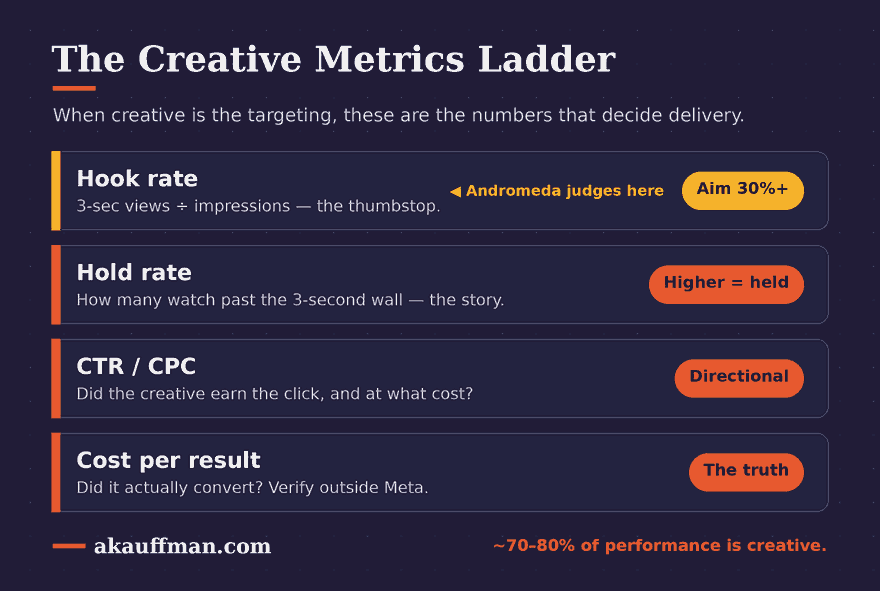
- Hook rate (3-second views ÷ impressions) is the thumbstop. If your creative loses most viewers before second three, Andromeda reads that as low-quality engagement and pulls back delivery. Common benchmarks put ~25% as a floor, 30%+ as good, and 35%+ as genuinely scalable — treat those as directional, not gospel.
- Hold rate is the story — how many viewers stay past that three-second wall. A strong hook with a weak hold is a great trailer for a bad movie.
- CTR / CPC tells you whether the creative earned the click, and at what cost.
- Cost per result is the only number that pays the bills — and you should verify it outside Meta, because the platform’s attribution is famously generous to itself.
The through-line: judge creative like it’s 70–80% of your performance, because it is.
Measure it outside Meta
Meta’s attribution, even on click, takes all the credit it can get. That’s not a knock — it’s just the incentive structure, the same one behind the optimization score being a to-do list Google wrote for itself and PMax reporting where an impression spike isn’t a win. Tag your URLs, watch the traffic land in GA4, and reconcile Meta’s self-reported wins against what actually converted on your site. Meta often shows up early in the buying journey and then hands off to search — useful to know, but only if you’re measuring the whole path rather than trusting one platform’s scorecard. It’s the same discipline of grounding every decision in real numbers I apply to paid search.
So what do you actually test?
Since differentiation is what feeds the machine (and what fends off fatigue — Meta treats near-identical assets as the same ad), build tests around genuinely different creative, not five tweaks of the same image:
- Illustrated/vector vs. photography
- Stock vs. your own brand photography
- Static vs. motion
- Text-heavy vs. minimal
- Scrappy “phone” video vs. polished production
Then read the winners on hook and hold first, conversions second — and don’t permanently write off a style because it lost once. Audiences move; retest periodically.
This is why the Meta-vs-TikTok question is really one question
For a client splitting budget across Meta and TikTok, here’s the unlock: both are creative-led, AI-delivered feeds. On both, the thumbstop and the retention decide your delivery and your costs. So the operating model is the same on each — produce a volume of differentiated creative, judge it on hook/hold plus real downstream conversions, and feed the winners to the algorithm. The creative that earns attention on one is worth testing on the other (with the caveat that what wins on Meta isn’t guaranteed to win on TikTok — each feed has its own native language).
That reframes the budget debate. It’s less “which platform gets the money” and more “do we have a creative engine good enough to feed both.”
On Meta and TikTok in 2026, creative is the media buying. The person who controls the creative controls the targeting.
My POV: creative is the new media buying
Here’s the tell that separates a vendor from a partner. A vendor spends the engagement fiddling with audience settings and campaign structures that barely move the needle anymore, then blames the algorithm. A partner builds a creative testing engine — a steady pipeline of differentiated concepts, judged on the right metrics, measured outside the platform — because on Meta and TikTok in 2026, creative is the media buying. The person who controls the creative controls the targeting.
The bottom line
Stop asking who you’re targeting on Meta and start asking what you’re putting in front of the algorithm. Your creative now determines your target audience — Andromeda picks the people, you pick the asset, and the hook and hold rates decide whether you scale or stall. Get the creative engine right, and the targeting takes care of itself. Get it wrong, and no amount of audience tinkering will save the spend.
Thinking about how to split a Meta and TikTok budget?
Book a free strategy call and we’ll build a creative-testing plan that works across both — and measure it where the truth actually lives.