For fifteen years, Google Ads keyword research meant building the list. Pick the right terms, group them tightly, bid on them, and the list decided who saw your ad. The classic process still gets taught the same way: audit the site, mine Search Console, study competitors, build the list, build negatives, validate in Keyword Planner, segment by intent. It’s a good process. I’d hand it to a new hire tomorrow.
But there’s a shift underneath it that changes what the research is for. In 2026 your keyword list no longer decides who sees your ad. It suggests. Google’s matching decides, and Google’s matching has gotten a lot more ambitious. So the list is now the starting point and the fence around it is the work.
What actually changed
Three things, and they stack. Exact match includes close variants: misspellings, plurals, reordered words, and paraphrases Google judges to mean the same thing. “Exact” hasn’t meant exact for years, and it means less every year. Broad match has become the default Google steers you toward, and it matches on meaning, not words. And since September 1, campaigns using automatically created assets or campaign-level broad match are being auto-upgraded to AI Max, which turns on search term matching: keywordless expansion that finds queries you never listed.
Put those together and the honest description of a 2026 Search campaign is this: you give Google a list of examples, and it goes looking for more. The quality of your keyword research now shows up in two places: how good the examples are, and how well you’ve fenced off where the system can wander.
What still holds
The intent framework is the durable part. “Software,” “pricing,” “best,” “for [industry],” “agency” signal a buyer; “how to,” “free,” “template,” “jobs,” “salary” signal everyone else. Starting with the client’s own site copy and Search Console data before opening a paid tool is exactly right, and it’s the step agencies skip when they’re in a hurry. Proactive negatives instead of reactive ones is the single most valuable habit in the whole process. And tight ad groups still lift Quality Score and, more importantly, keep the ad, the query and the landing page saying the same thing.
For my home-services and local clients the modifiers change but the logic doesn’t. Buyers type “near me,” “emergency,” “same day,” “cost,” “repair,” “installers,” and the name of their town. Browsers type “how to fix,” “DIY,” “parts,” “vs,” and “jobs.” Same framework, different vocabulary, and it’s worth writing the vocabulary down per client before you touch a tool.
Where the classic playbook is out of date
Exact match as the control strategy. The classic advice is exact match, because broad match wanders. Fair, but exact match wanders too, just less, and Google keeps widening it. Betting the account’s efficiency on a match type Google is actively loosening is a plan with an expiration date. The durable control is the negative list and the conversion signal, not the match type.
Keyword Planner CPCs as a bid ceiling. With Smart Bidding running most accounts, you rarely set a max CPC anymore. Planner’s CPC range is still useful, but as a budget sanity check and a competitiveness read, not a bid. I use it to answer one question: can this client afford to be in this auction at all?
Segmenting by intent tier for bid control. Separate campaigns for “highest intent” versus “general” made sense when you bid manually. With tCPA or tROAS, splitting thin conversion volume across campaigns can starve the algorithm. I’d rather segment by service line and let the bid strategy value the intent, unless the account has enough conversions to feed both.
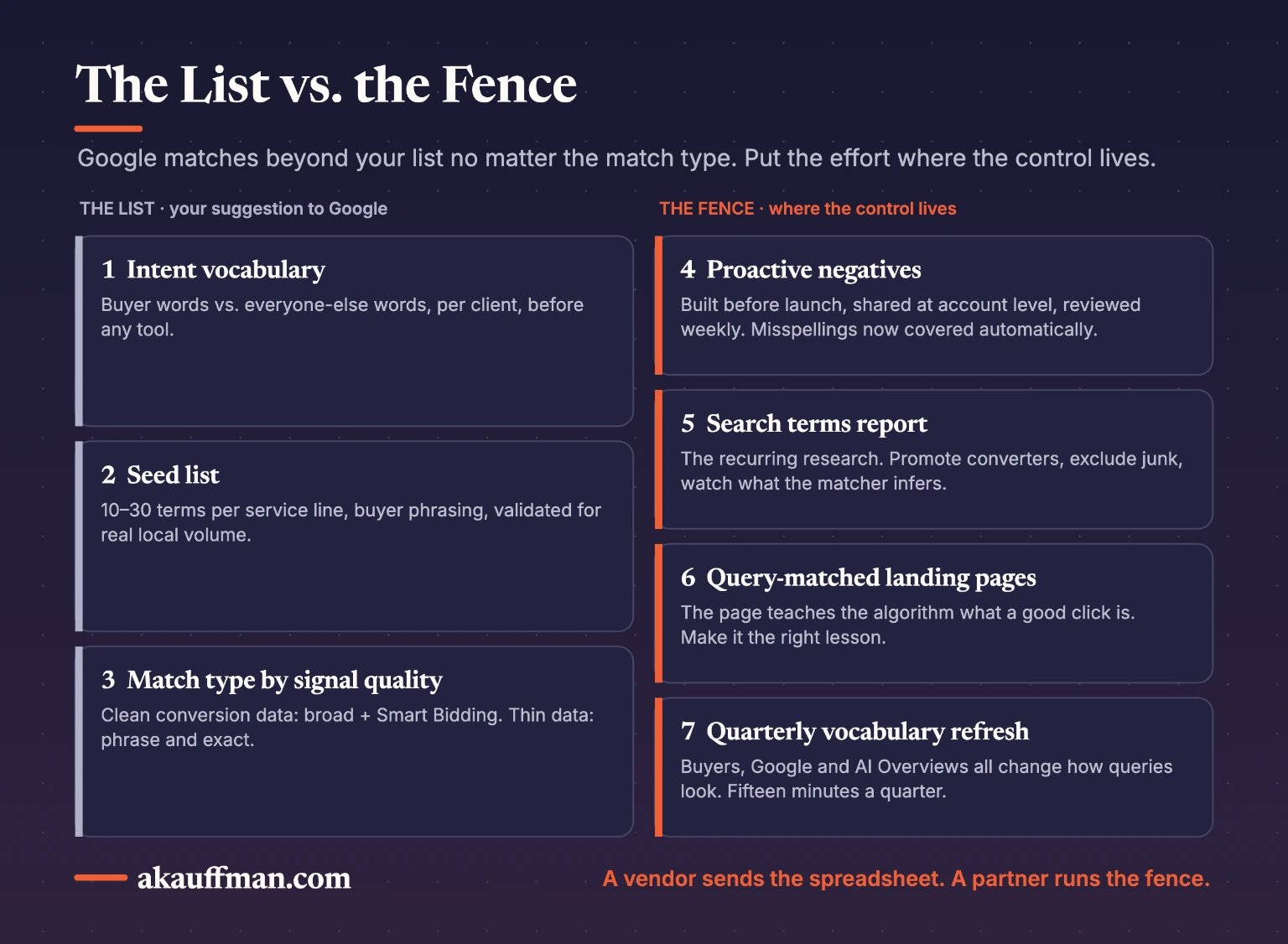
In 2026 the keyword list is a suggestion. The negatives, the conversion signal and the search terms report are the strategy.
The 2026 version, in the order I’d run it
1. Write the intent vocabulary before you open a tool
Site copy, Search Console, five minutes with whoever answers the phone. Two columns: words a buyer uses, words everyone else uses. Every later step is filtered through this list, including the negatives you’ll build in step 4.
2. Build the seed list, and keep it honest
Ten to thirty keywords per service line, phrased the way buyers phrase them, validated in Keyword Planner for real volume in the client’s actual geography. Competitor tools (SpyFu, Semrush, either is fine) tell you what others are paying for. Don’t copy their list; use it to find the terms you’d have missed and the ones nobody’s bidding on.
3. Choose match types by how much you trust the conversion signal
Clean conversion tracking with real volume: broad match and Smart Bidding will find more than you can. Thin or noisy conversions: phrase and exact, so the system has less room to be wrong. Match type isn’t a philosophy; it’s a function of how good your data is. This is the same judgment as deciding whether your target is a target.
4. Build the negative list before launch, then treat it as the product
Everything in the “everyone else” column, plus job terms, competitor names you don’t want to pay for, and off-service work. Google’s negative keywords now cover misspellings and casing automatically, which removes an old chore but doesn’t remove the need for a shared account-level list you review weekly. In an AI Max world, the negative list is the closest thing you have to a keyword list.
5. Make the search terms report the recurring keyword research
The list you launched was your hypothesis. The search terms report is the data. Weekly for the first month, then biweekly: promote converting queries to keywords, add the junk to negatives, and watch what the matcher is inferring about your business. If it’s wandering somewhere wrong, the fix is usually a missing negative or a landing page that’s teaching it the wrong lesson.
6. Match the landing page to the query, not the campaign
A “water heater replacement cost” click should land on a page about water heater replacement with a price range on it, not the services overview. Relevance here lifts Quality Score, lowers the CPC you’d otherwise blame on the auction, and feeds the matcher clean conversion data so it wanders less.
7. Re-read the vocabulary quarterly
Buyers change how they search, Google changes how it matches, and AI Overviews are absorbing a growing share of the “how to” queries you were excluding anyway. Fifteen minutes a quarter to refresh the two columns keeps the whole system pointed at the right people.
The balanced take
None of this makes the list-building steps obsolete. A lazy seed list still produces a lazy campaign, and the classic discipline around intent modifiers and proactive negatives is worth more now, not less, because the matching is looser. What I’m arguing against is treating the list as the finished product and the match type as the safety. The finished product is the fence: negatives, conversion signal, landing pages, and a weekly look at what Google actually bought.
My POV
Clients still ask me for “the keyword list” like it’s a deliverable you hand over once. It used to be. Now the deliverable is a running system: a vocabulary, a seed list, a negative list that grows every week, and someone reading the search terms report who knows the business well enough to tell a buyer from a browser. A vendor sends the spreadsheet. A partner runs the fence.
The bottom line
Do the classic research; it’s good. Then accept that Google will match beyond it no matter which match type you pick, and put your effort where the control actually lives: a proactive negative list, clean conversion data, pages that match the query, and a search terms report you read like a P&L. That’s keyword research for the campaign you’re actually running in 2026, not the one from 2016.
Related reading: Google is upgrading you to AI Max. Do it on your terms. · CPC inflation starts before the auction
Want a second look at what Google is actually matching you to?
I’ll pull 90 days of search terms, show you where the spend is wandering, and rebuild the negative list and seed list around the buyers you want. Book a call.